• Skip to primary navigation
  • Skip to main content
  • Skip to primary sidebar

Geoff's Miscellany

Miscellaneous Musings

Archives for January 2019

On Why We Need Logic

January 11, 2019 by Geoff 1 Comment

John Henry Newman was talking about his own era, but his thoughts are relevant today:

It were well if none remained boys all their lives; but what is more common than the sight of grown men, talking on political or moral or religious subjects, in that offhand, idle way, which we signify by the word unreal? “That they simply do not know what they are talking about” is the spontaneous silent remark of any man of sense who hears them. Hence such persons have no difficulty in contradicting themselves in successive sentences, without being conscious of it. John Henry Newman, The Idea of a University Defined and Illustrated (London: Basil Montagu Pickering, 1873), xvii.

Learning basic logic is crucial for training in moral, academic, and practical formation. For example, being able to infer what somebody else would find offensive or pleasant takes logic. Similarly, determining contradictions between behavior and ideals takes logic. This is why some of the Pharisees hated Jesus. He applied logic to them in order to point out their hypocrisy. Logic and simply processes of elimination are very important in various service industries and home repairs that very few people my age can do that I remember all adults being able to do when I was younger (case in point: I totally missed a very simple fact when working on my car, the radiator reservoir had water…but the radiator didn’t, but I didn’t check the radiator, I jumped straight to replacing the thermostat, thankfully my uncle solved the problem).

Yet, despite its advantages, logic is not typically a part of the curriculum in most fields. It was not a part of my training in seminary nor was it a part of my undergraduate degree. Logic is not a requirement for my engineering degree either (though you have to learn it intuitively in computer programming, circuits, and mathematics). I learned logic in high school from a rogue English teacher who was not following the curricular guidelines and it has been a study of mine since then. I talked to a logic professor just last year after watching a debate he moderated. We discussed how amazing it is that essentially the same syllogistic rules work for inference in all fields and apparently in all physical space. He said, “That is troubling for me as an atheist. But have you read about Graham Priest’s paraconsistent logic?” This is precisely the trouble. Instead of teaching the thing that works and is supremely useful, we find logic replaced by theoretical substitutes apparently for the rhetorical purpose of making the universe seem less orderly.

I would guess that the inability of many people to follow a basic syllogism, find the hidden premise in an enthymeme, or discover contradictions, fallacies, and necessary truths leaves them in a state of confusion. Being able to determine what merely may be, or is likely to be true and what must be true is so crucial in our world of data overload.

I suppose the solution is to learn logic yourself (by a textbook or two) and start applying it to your life. Also, teach it to your children. Have classes at church. It’s more important than we realize, which is exactly the problem. We do not even realize we’re flying blind without logic precisely because we no longer use it.

Share:

  • Click to share on Facebook (Opens in new window) Facebook
  • Click to share on Reddit (Opens in new window) Reddit
  • Click to share on X (Opens in new window) X
  • Click to share on Pocket (Opens in new window) Pocket

Filed Under: Dialectic, Education Tagged With: education, Thoughts

In all toil there is profit

January 10, 2019 by Geoff Leave a Comment

In all toil there is profit, but mere talk tends only to poverty.

(Proverbs 14:23 ESV)

The proverb above is one I have always associated with one particular type of talk: talking about what you’re going to do instead of doing it.

I think that this aspect is true, but incomplete. I have overly limited the meaning of talk.

Here are forms of talk that are justifiably included under this heading because they replace labor and thus prevent profit:

  1. Being critical of others to the neglect of self-reflection or self-improvement
  2. Being a whiner, complainer, or malcontent
  3. Making excuses and being a wimp (we’re all going to die anyway)
  4. Talking about other people’s accomplishments without accomplishing anything yourself
  5. Talking about how other people messed up your life
  6. Talking about what you would do if only you had this or that
  7. Talking about theology instead of praying, reading Scripture, learning Greek/Hebrew, or putting the words of Jesus into practice.
  8. Talking about what other churches do wrong instead of fixing your own church
  9. Complaining about your neighbors instead of ordering your own household or picking up garbage when you go for a walk
  10. Complaining about the government without knowing local politician’s names or platforms or voting
  11. Preaching sermons but not praying, meditating, or otherwise attending to matters of personal spiritual care
  12. Having endless meetings at work but doing no work
  13. Being a part of dozens of Bible studies but not studying for your calling
  14. Being a part of dozens of Bible studies but not memorizing or reading any of the Bible
  15. Talking about your crush and never asking him/her out

I’m sure that this isn’t comprehensive, but I hope it helps.

Any other aspects of “mere talk” that distract from actual labor and therefore from profit?

Share:

  • Click to share on Facebook (Opens in new window) Facebook
  • Click to share on Reddit (Opens in new window) Reddit
  • Click to share on X (Opens in new window) X
  • Click to share on Pocket (Opens in new window) Pocket

Filed Under: Bible, Christianity Tagged With: discipleship, Proverbs, Thoughts

Martial arts for your mind: thought kata

January 10, 2019 by Geoff 1 Comment

One of the great analogies for growing in virtue is that of a battle against the passions and appetites. The particular virtues which are like a battle to develop are temperance and fortitude.

[Read more…] about Martial arts for your mind: thought kata

Share:

  • Click to share on Facebook (Opens in new window) Facebook
  • Click to share on Reddit (Opens in new window) Reddit
  • Click to share on X (Opens in new window) X
  • Click to share on Pocket (Opens in new window) Pocket

Filed Under: Thought Kata, Mindset Tagged With: intellectual virtues, temperance, cardinal virtues

John Wesley on Foreknowledge and Election

January 10, 2019 by Geoff 3 Comments

Below, you’ll find 1 Peter 1:1-2 and John Wesley’s comments on vs 2. Over all, I find what he says to be convincing. The idea that the descriptions of God’s fore or after knowledge in the Bible are metaphorical is perfectly reasonable. It is just as much true that predestination is a metaphor as it is true that God’s being surprised or ignorant is as well.

Peter, an apostle of Jesus Christ, to the strangers scattered throughout Pontus, Galatia, Cappadocia, Asia, and Bithynia, Elect according to the foreknowledge of God the Father, through sanctification of the Spirit, unto obedience and sprinkling of the blood of Jesus Christ: Grace unto you, and peace, be multiplied.
(1 Peter 1:1-2 KJV)

[Quote] According to the foreknowledge of God – Speaking after the manner of men. Strictly speaking, there is no foreknowledge, no more than afterknowledge, with God: but all things are known to him as present from eternity to eternity. This is therefore no other than an instance of the divine condescension to our low capacities. Elect – By the free love and almighty power of God taken out of, separated from, the world. Election, in the scripture sense, is God’s doing anything that our merit or power have no part in. The true predestination, or fore – appointment of God is:

1.  He that believeth shall be saved from the guilt and power of sin.

2. He that endureth to the end shall be saved eternally.

3. They who receive the precious gift of faith, thereby become the sons of God; and, being sons, they shall receive the Spirit of holiness to walk as Christ also walked.

Throughout every part of this appointment of God, promise and duty go hand in hand. All is free gift; and yet such is the gift, that the final issue depends on our future obedience to the heavenly call. But other predestination than this, either to life or death eternal, the scripture knows not of. Moreover, it is:

1. Cruel respect of persons; an unjust regard of one, and an unjust disregard of another.

2. It is mere creature partiality, and not infinite justice.

3. It is not plain scripture doctrine, if true; but rather, inconsistent with the express written word, that speaks of God’s universal offers of grace; his invitations, promises, threatenings, being all general.

We are bid to choose life, and reprehended for not doing it. It is inconsistent with a state of probation in those that must be saved or must be lost. It is of fatal consequence; all men being ready, on very slight grounds, to fancy themselves of the elect number. But the doctrine of predestination is entirely changed from what it formerly was. Now it implies neither faith, peace, nor purity. It is something that will do without them all. Faith is no longer, according to the modern predestinarian scheme, a divine “evidence of things not seen,” wrought in the soul by the immediate power of the Holy Ghost; not an evidence at all; but a mere notion. Neither is faith made any longer a means of holiness; but something that will do without it. Christ is no more a Saviour from sin; but a defence, a countenancer of it. He is no more a fountain of spiritual life in the soul of believers, but leaves his elect inwardly dry, and outwardly unfruitful; and is made little more than a refuge from the image of the heavenly; even from righteousness, peace, and joy in the Holy Ghost. Through sanctification of the Spirit – Through the renewing and purifying influences of his Spirit on their souls.
Unto obedience – To engage and enable them to yield themselves up to all holy obedience, the foundation of all which is, the sprinkling of the blood of Jesus Christ – The atoning blood of Christ, which was typified by the sprinkling of the blood of sacrifices under the law; in allusion to which it is called “the blood of sprinkling.” [End Quote]

Hopefully Wesley’s point of view is helpful to you.

Share:

  • Click to share on Facebook (Opens in new window) Facebook
  • Click to share on Reddit (Opens in new window) Reddit
  • Click to share on X (Opens in new window) X
  • Click to share on Pocket (Opens in new window) Pocket

Filed Under: Contemporary Trends, Bible, Christianity Tagged With: 1 Peter, Calvinism, Election, free will, John Wesley

Water from the Desert: Evagrius of Pontus

January 10, 2019 by Geoff Leave a Comment

  1. Evagrius was a desert monk who lived from 345-399. He was well known for his academic abilities and was frequently sought after for his wisdom but fled the life of popular acclaim upon being tempted to have an affair (think Joseph and Potiphar’s wife).
  2. An anonymous history, Historia Monachorum testifies of him, “We also visited Evagrius, a wise and learned man who was skilled in the discernment of thoughts, an ability he had acquired by experience. He often went down to Alexandria and refuted the pagan philosophers in disputations…He taught us much else about ascesis, strengthening our souls.” His work was described as “training his intellect to examine his thoughts systematically (Palladius’ Coptic Life). This “thinking about thinking” was seen as a direct continuation of Jesus’ command to repent, because the Greek word behind it means, “rethink your thoughts.”
  3. Evagrius’ Core ideas (In his book, “153 sayings on Prayer):
    1. He would often use the word “demons” for bad thoughts.
    2. The pursuit of the good (especially spiritual prayer) is hindered by the passions: “What is it that the demons wish to excite in us? Gluttony, unchastity, avarice, anger, rancor, and the rest of the passions, so that the intellect grows coarse and cannot pray as it ought. For when the passions are aroused in the non-rational part of our nature, they do not allow the intellect to function properly.”
    3. “When the demons see you truly eager to pray, they suggest an imaginary need for various things, and then stir up your remembrance of these things, inciting the intellect to go after them; and when it fails to find them, it becomes very depressed and miserable.”
      1. This is analogous to your experience sitting down to do homework or deciding to clean your room, or resolving to exercise, etc.
    4. What is spiritual prayer? “Whether you pray with brethren or alone, try to pray not simply as a routine, but with conscious awareness of your prayer. Conscious awareness of prayer is concentration accompanied by reverence, compunction and distress of soul as it confesses its sins with inward sorrow.”
    5. How does one dispell the passions and distracting thoughts which stir them up? “He who has mastery over his incensive power has mastery also over the demons. (Discrimination of Passions and Thoughts)”
    6. Finally, here’s his thought on how the Christian interested in daily growing in Christlikeness ought to live, “A monk should always act as if he was going to die tomorrow; yet he should treat his body as if it was going to live for many years. The first cuts off the inclination to listlessness, and makes the monk more diligent; the second keeps his body sound and his self control well balanced” (Texts on Watchfulness).

Share:

  • Click to share on Facebook (Opens in new window) Facebook
  • Click to share on Reddit (Opens in new window) Reddit
  • Click to share on X (Opens in new window) X
  • Click to share on Pocket (Opens in new window) Pocket

Filed Under: Christianity

Sanctification, Repentance, and the Habit Loop

January 10, 2019 by Geoff Leave a Comment

Introduction to Concept:

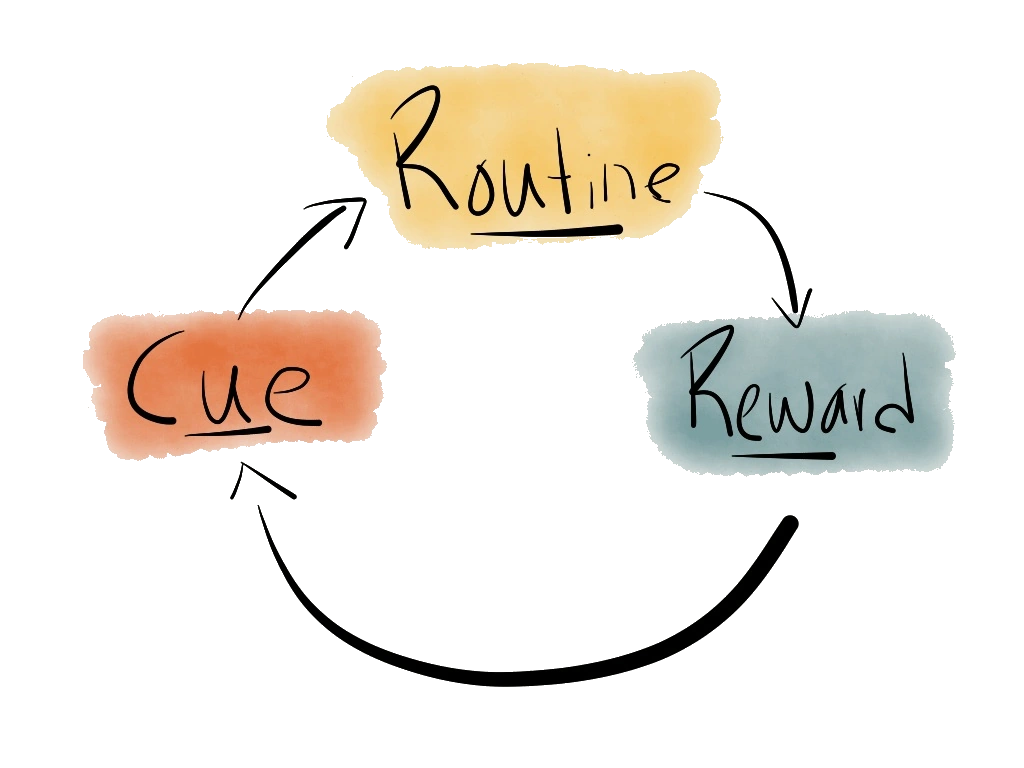
In his book The Power of Habit, Charles Duhigg explains something advertisers have known for quite some time: human beings can be trained to respond to cues with routines as long as there is a reward. He calls this the habit loop. It looks like this:

The idea is that when we have a cue, we usually will follow a certain routine that leads to a reward and if this cue occurs enough times it becomes a habit and is very difficult to break. Many habits have no particular reward but are still hard to break. Think about things Americans do not eat (cartilage, fat, and animal skin) that are good for you and if you do not eat these things, think about how gross it feels to try eating them.

Duhigg’s model of habit formation is especially interesting Christians who wish to use spiritual disciplines, obtain some virtue, or overcome some particular sin.

Keep in mind this paragraph from Jesus’ brother:

Jas 1:13-15 ESV  Let no one say when he is tempted, “I am being tempted by God,” for God cannot be tempted with evil, and he himself tempts no one. (14) But each person is tempted when he is lured and enticed by his own desire. (15) Then desire when it has conceived gives birth to sin, and sin when it is fully grown brings forth death.

James’ answers the question, “Who is the go-to guy for blame when we sin?” Who is it? The person who sins. Or, to put it more personally, we are responsible for the temptations to sin that come our way. Desire is the cue, this or that sinful action or constellation of thoughts and actions is the routine, and desire fulfillment is the reward.

Personal Case Study

I have a tendency to struggle with acedia. It’s essentially a feeling of weird existential boredom that leads to sloth. The best cure for it, in the moment it attacks, is to pray, do something physically productive, and move on with life. The thing about acedia is that it never really happens at work, but it can happen after a really productive event or series of events at work. Now, coupled with acedia, I love information. My grandfather used to think it was weird how I always had “factoids” that seemed to have no practical use. He’s right. I remember, though I can’t place the story, when Holmes told Watson, “I am an omnivorous reader with a strangely retentive memory for trifles.” This love for knowledge coupled with a periodic lack of motivation to exert effort causes what the medieval scholars called “curiosity.” Not the good kind that leads to scientific discovery, but the waste of time kind wherein you simply search for novelty. I suppose that if I were less conscientious it would be the sort of feeling that makes one easily addicted to drugs (and I am susceptible to binge playing video games when I cannot sleep).

  1. Cue: Feelings of lack of motivation coupled with a constant desire to know things.
  2. Routine: The internet now exists: follow links, listen to music, and read pointless articles.
  3. Reward: Dozens of silly facts rather in the same time it would take me to read one sustained argument concerning an important truth, perform one satisfying repair to part of my home, or write one chapter of a commentary on the Sermon on the Mount I am trying to finish by the end of the year.

Duhigg prescribes two paths to change the habit loop:

  1. Keep the cue and reward the same, but change the routine. To change the routine, Duhigg notes that we must come to understand precisely what craving is set off by the cue. For instance, a shopping addict might have the desire to accomplish something, but the routine (buying something on credit) is so easy that it is the only option that comes to mind until the loop is further examined by the obsessive clothing buyer.
  2. Remove the cue. Removing the cue only goes so far, but it is better than nothing. For instance, one would no longer be able to binge-watch The Office and eat sweets if they canceled their internet service and only bought meat, eggs, and veggies at the store.

Two Necessary Things to Keep in Mind

There remain two other elements to changing the habit loop:

  1. The role of belief
  2. The education of desire

As to the first idea, Duhigg observes that belief plays a crucial role in long term habit transformation (82-86). In the case of athletes, they have to believe that the new habits will help them succeed. Similarly, AA members who commit to the steps and the whole program are more successful when they actually believe in the higher power (84). In the case of Christianity there is a cluster of beliefs that are important for manipulating the moral habit loop:

  1. Sin really is disgusting and bad for you
  2. The way of Christ is meant to give you joy (often now, but infinitely so in eternity)
  3. You are dead to sin (in other words, it is not your master and you always have a way out)
  4. God will help you

The second element, the education of desire, is implied by Duhigg but made explicit in Scripture and ancient philosophy.[1] This should not be news to us. Many people grow to love the routine of exercise no matter how grueling, people start to enjoy the taste of healthy food on a new diet. For instance, I can only drink one or two types of soda now since I went about four years without a sip of the stuff. Soda, even a sip, burns my mouth and is so sweet that it makes my teeth hurt. If Christianity is true, it stands to reason that the process of habit formation applies to the moral life we see in Scripture as well. And we do see this.

Paul speaks of being transformed by the renewing of the mind. This implies that one can change for the better over time. Similarly, Peter speaks of growing in grace and knowledge. It is also the case that John and James speak of love and faith being perfected in us, respectively. The author of Hebrews says that we should strengthen our weakened joints in our quest for holiness and so-on (Hebrews 12:12). In other words, God shapes our desires through the habits we develop.

References

[1] In order to fully change our character, eventually our choices and then habits, must result in an incremental change of desire toward the good. Jesus talks about this difference of orientation in several places. For instance, he observes that the Pharisees do their religious rituals in order to hide their sin from others rather than as acts of faith, hope, and love toward God (which obeying the Law was always meant to be, see Psalm 19:7). So, when one begins to put to death sinful habits and to put holy habits into practice in their place out of sincere trust and hope in God, ones desires start to change.

Share:

  • Click to share on Facebook (Opens in new window) Facebook
  • Click to share on Reddit (Opens in new window) Reddit
  • Click to share on X (Opens in new window) X
  • Click to share on Pocket (Opens in new window) Pocket

Filed Under: Contemporary Trends, Book-Review, Christianity Tagged With: discipleship, speculative theology, Thoughts

  • « Go to Previous Page
  • Go to page 1
  • Interim pages omitted …
  • Go to page 4
  • Go to page 5
  • Go to page 6
  • Go to page 7
  • Go to Next Page »

Primary Sidebar

Recent Posts

  • 2020 Has Been a Big Year or I Finally Quit
  • Steps to Open a Bible College
  • You Have No Power Here, This is a Library
  • What is true wealth?
  • What’s Wrong with Conservatives?

Recent Comments

  • Sharon on Whether we live or die, Aslan will be our good lord.
  • Alishba lodhi on Effort Habit: Keep the Faculty of Effort Alive in You
  • Geoff on Why is Covetousness Idolatry?
  • Geoff on 2020 Has Been a Big Year or I Finally Quit
  • Kelly Jensen on Why is Covetousness Idolatry?

Archives

  • August 2020
  • June 2020
  • May 2020
  • April 2020
  • March 2020
  • January 2020
  • December 2019
  • October 2019
  • September 2019
  • August 2019
  • June 2019
  • May 2019
  • April 2019
  • March 2019
  • February 2019
  • January 2019
  • December 2018
  • November 2018
  • October 2018
  • September 2018
  • August 2018
  • July 2018
  • June 2018
  • March 2018
  • February 2018
  • January 2018
  • December 2017
  • November 2017
  • October 2017
  • September 2017
  • August 2017
  • July 2017
  • June 2017
  • May 2017
  • April 2017
  • March 2017
  • February 2017
  • January 2017
  • December 2016
  • November 2016
  • October 2016
  • September 2016
  • August 2016
  • July 2016
  • June 2016
  • May 2016
  • April 2016
  • March 2016
  • February 2016
  • January 2016
  • December 2015
  • November 2015
  • October 2015
  • September 2015
  • August 2015
  • July 2015
  • June 2015
  • May 2015
  • April 2015
  • March 2015
  • February 2015
  • January 2015
  • December 2014
  • November 2014
  • October 2014
  • September 2014
  • August 2014
  • July 2014
  • June 2014
  • May 2014
  • March 2014
  • February 2014
  • January 2014
  • December 2013
  • November 2013
  • October 2013
  • September 2013
  • August 2013
  • July 2013
  • May 2013
  • March 2013

Cateories

WordPress · Log in