Geoff's Miscellany

Book-Review

Dallas Willard on the Beatitudes

January 31, 2019

Dallas Willard's understanding of the Beatitudes:

It will help us know what to do—and what not to do—with the Beatitudes if we can discover what Jesus himself was doing with them. That should be the key to understanding them, for after all they are his Beatitudes, not ours to make of them what we will. And since great teachers and leaders always have a coherent message that they develop in an orderly way, we should assume that his teaching in the Beatitudes is a clarification or development of his primary theme in this talk and in his life: the availability of the kingdom of the heavens. How, then, do they develop that theme?

Hedonism, Love, and Goodness

January 12, 2019

The things that shape who we are and how we think are pluriform and sometimes mysterious. This is especially so in the age of the internet stuff that may disappear forever after you read it. Every once in a while, the Internet sends it back to you.

Around 2008-2009, I was quite depressed. And while I was still known for being a social butterfly at work and school, and many people even called me for advice (I remember distinctly two women with doctorates in psychology contacting me for relationship advice), I was languishing. There are probably three main reasons for this:

Sanctification, Repentance, and the Habit Loop

January 10, 2019

Introduction to Concept:

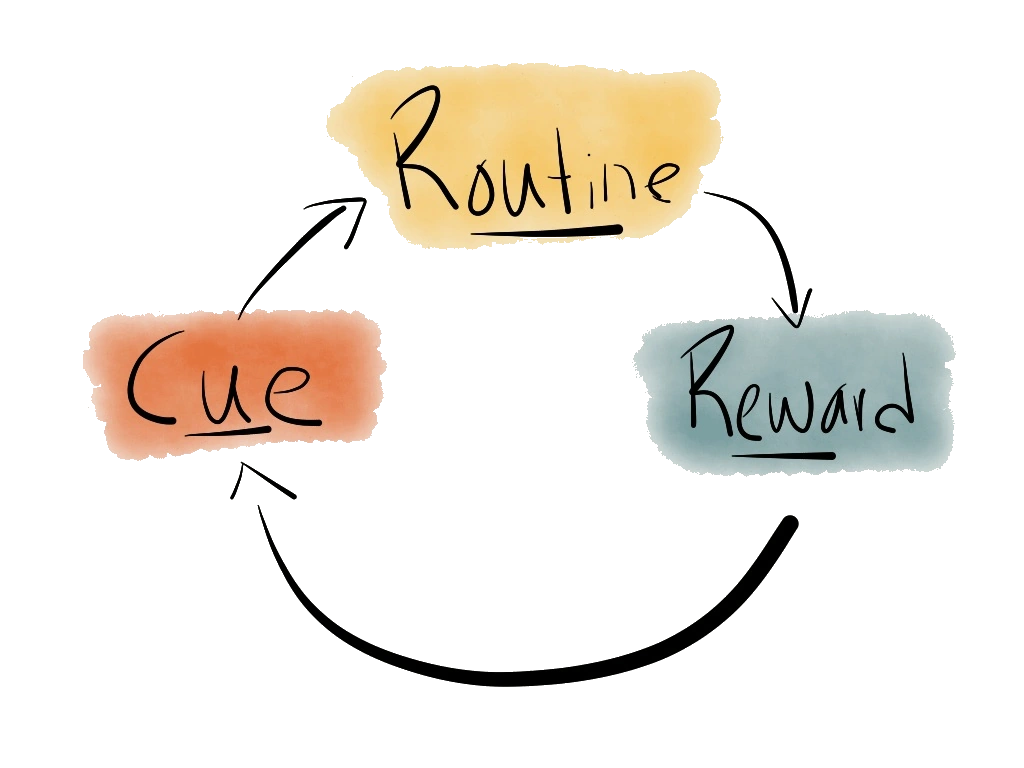
In his book The Power of Habit, Charles Duhigg explains something advertisers have known for quite some time: human beings can be trained to respond to cues with routines as long as there is a reward. He calls this the habit loop. It looks like this:

The idea is that when we have a cue, we usually will follow a certain routine that leads to a reward and if this cue occurs enough times it becomes a habit and is very difficult to break. Many habits have no particular reward but are still hard to break. Think about things Americans do not eat (cartilage, fat, and animal skin) that are good for you and if you do not eat these things, think about how gross it feels to try eating them.

Tales of the Mountain Men

December 19, 2018

My book club recently read Tales of the Mountain Men, a collection of excerpts about mountain men, edited by Lamar Underwood. While it has interesting stories, each segment ended right when it got interesting. It felt like I paid Underwood 12 dollars to advertise other authors’ books. So as a book, it gets like 5/10 or even less. But the experience of reading the excerpts was pretty good. It would be a great book to get from a library. Two of the paragraphs were so good, that I’ll reproduce them here with some comments.

Book Review: Jordanetics by Vox Day

November 23, 2018

Jordanetics by Vox Day

Vox is a guy who probably needs no introduction. If there is some kind of controversy involving the internet and its intersection with political ideology, Vox has something to say about it. His main writing efforts have been aimed at fiction, but he also writes political philosophy, general philosophy, and economics books. His writing is prolific, to say the least, and he’s fairly bright. When I discovered he wanted to take on Jordan Peterson, I figured it would be a fun read. Regarding Peterson, I started out a big fan because he talked about the value of free-speech, tried to speak about the mythopoetic value of the Biblical stories (which is valuable for Christians and non-Christians alike), used observations from evolutionary psychology, and tried to help young people obtain some degree of future orientation (though there has been a study of the future authoring program showing smaller or no effect size).

Book Review: Poor Richard's Retirement

February 6, 2018

Aaron Clarey, Poor Richard’s Retirement: Retirement for Everyday Americans

Aaron Clarey is a consultant and independent economist who writes books that are meant to help young men and women make wiser financial choices. His approach is no nonsense, gruff, and often cynical. But despite seeming like a complete jerk, his advice which is free on his blog or youtube channel clearly comes from a big heart (for sensitive users or those who may listen w/children around, he does curse a lot). This is evident when he, for instance, criticizes parents who don't spend a great deal of time with their children (this is a common thread in his books and podcasts and I only listen to them a couple of times a year).

Book Review: The Gospel of Happiness

January 18, 2018

Book Review: The Gospel of Happiness: Rediscover Your Faith Through Spiritual Practices and Positive Psychology by Christopher Kaczor

Introduction

I found out about this book from twitter, when James K.A. Smith mentioned anticipating it's release. I had never heard of the author before, but he's an ethics professor with his PhD from Notre Dame.

The aim of the book is stated on page 18:

In this book, I highlight the many ways in which positive psychology and Christian practice overlap. I point out empirical findings in positive psychology that point to the wisdom of many Christian practices and teachings. I also provide practical suggestions on how to become happier in everyday life and how to deepen Christian practice based on contemporary psychological insights. All of this points us toward deeper fulfillment in this life, and in the life to come. This is why I titled this book The Gospel of Happiness – because this is good news, very good news indeed (18).
The argument is fairly obvious from chapter to chapter. The chapter titles are:
  1. The Ways to Happiness
  2. The Way of Faith, Hope, and Love
  3. The Way of Prayer
  4. The Way of Gratitude
  5. The Way of Forgiveness
  6. The Way of Virtue
  7. The Way of Willpower

Dr. Kaczor looks at the relevant psychological research concerning each topic as well the Biblical and historical teachings of Christianity and shows their coherence and overlap. After he makes these comparisons he makes recommendations for personal practice.

Jesus Christ and Mythology by Rudolf Bultmann: A Review

December 29, 2017

Rudolf Bultmann, Jesus Christ and Mythology New York, NY: Scribners, 1958

Introduction

Bultmann really needs no introduction. If you do not know much about him there are numerous articles available online. The main purpose here is simply to review this particular book which is a collection of Lectures he gave at Yale and Vanderbilt in 1951. The topic of the book is Bultmann's radical method of New Testament interpretation: de-mythologizing. I've never heard anybody explain what Bultmann meant by this term on Bultmann's terms. According to this little volume, de-mythologizing is the interpretation of the Bible's mythological statements (statements which presuppose an ancient and, to the modern man, unbelievable worldview) in a way that makes them immediately relevant to the contemporary person. An example would be, “The understanding of God as creator is genuine only when I understand myself here and now as the creature of God. This existential understanding does not need to express itself in my consciousness as explicit knowledge. In any case the belief in the almighty God is not the conviction given in advance that there exists an almighty Being who is able to do all things. Belief in the almighty God is genuine only when it takes place in my very existence, as I surrender myself to the power of God who overwhelms me here and now” (Bultmann, 63). The rhetorical and theological purpose for Bultmann utilizing this interpretive method is that, “We can believe in God only in spite of experience, just as we can accept justification only in spite of conscience...de-mythologizing is the radical application of the doctrine of justification by faith to the sphere of knowledge and thought” (84). In other words, he feels that we cannot expect people to accept the statements of the Bible as true, conceptually, for that would be works, not faith.
Eric Johnson's Proposal for Christian Reading

November 21, 2017


Eric L. Johnson, Foundations for Soul Care: A Christian Psychology Proposal[1]

Below is a summary of Johnson’s rules for Christian reading. It’s a useful part of his book. Because these are my own words, anything poorly stated is my own fault, not Johnson’s.

  1. The goal of Christian reading, even leisure reading, is conformity to Christ. Therefore what and how we read matter.
  2. The Holy Spirit is the Christian reading light. This metaphor indicates that while reading, the Christian is cooperating with the Holy Spirit in coming to have self-knowledge, knowledge about what is being read, knowledge about the author, knowledge about the world, and knowledge about God.
  3. New Christians should ask wise guides for help in reading, both what to read, and how to understand it.
  4. There is a natural hierarchy in the texts we read:
    1. The canon of Scripture.
    2. Classic texts of the Christian traditions.
    3. Other quality texts (I would add, classical texts of one’s national, ethnic, or intellectual tradition).
    4. Inferior texts that aren’t worth reading.
    5. Bad texts which draw the readers from what is true, good, or beautiful.
    6. Banned texts, some texts are simply justifiably censured and censored.
  5. Non-Canonical texts need to be read with trust and suspicion.
  6. Reading non-Christian texts wisely increases wisdom and is therefore worthwhile.

References

[1] Eric L. Johnson, Foundations for Soul Care: A Christian Psychology Proposal (InterVarsity Press, 2007), 222-226.

Simplify: a review

October 5, 2017

Back in 2008, I saw a review for Simplify by Paul Borthwick over at Internet Monk, back before Mike Spencer died. I bought the book immediately. I found that despite its price tag ($16.99), it contained a wealth of valuable information. It’s exactly what it says it will be. A book about the practical side of simplifying your life, especially with respect to finances and time. I read it as soon as I purchased it and starting applying its principles. My wife then read it (I lent it to her before we were even dating). And it has helped us to live rather simply. It’s principles are worth revisiting periodically. I was reorganizing my library (it must be done often because I always pull volumes off the shelf and lazily put them wherever I can reach), and saw it and reread it.