Geoff's Miscellany

Christianity

Water from the Desert: Evagrius of Pontus

January 10, 2019

  1. Evagrius was a desert monk who lived from 345-399. He was well known for his academic abilities and was frequently sought after for his wisdom but fled the life of popular acclaim upon being tempted to have an affair (think Joseph and Potiphar’s wife).
  2. An anonymous history, Historia Monachorum testifies of him, “We also visited Evagrius, a wise and learned man who was skilled in the discernment of thoughts, an ability he had acquired by experience. He often went down to Alexandria and refuted the pagan philosophers in disputations...He taught us much else about ascesis, strengthening our souls.” His work was described as “training his intellect to examine his thoughts systematically (Palladius’ Coptic Life). This “thinking about thinking” was seen as a direct continuation of Jesus’ command to repent, because the Greek word behind it means, “rethink your thoughts.”
  3. Evagrius’ Core ideas (In his book, “153 sayings on Prayer):
    1. He would often use the word “demons” for bad thoughts.
    2. The pursuit of the good (especially spiritual prayer) is hindered by the passions: “What is it that the demons wish to excite in us? Gluttony, unchastity, avarice, anger, rancor, and the rest of the passions, so that the intellect grows coarse and cannot pray as it ought. For when the passions are aroused in the non-rational part of our nature, they do not allow the intellect to function properly.”
    3. “When the demons see you truly eager to pray, they suggest an imaginary need for various things, and then stir up your remembrance of these things, inciting the intellect to go after them; and when it fails to find them, it becomes very depressed and miserable.”
      1. This is analogous to your experience sitting down to do homework or deciding to clean your room, or resolving to exercise, etc.
    4. What is spiritual prayer? “Whether you pray with brethren or alone, try to pray not simply as a routine, but with conscious awareness of your prayer. Conscious awareness of prayer is concentration accompanied by reverence, compunction and distress of soul as it confesses its sins with inward sorrow.
    5. How does one dispell the passions and distracting thoughts which stir them up? “He who has mastery over his incensive power has mastery also over the demons. (Discrimination of Passions and Thoughts)”
    6. Finally, here’s his thought on how the Christian interested in daily growing in Christlikeness ought to live, “A monk should always act as if he was going to die tomorrow; yet he should treat his body as if it was going to live for many years. The first cuts off the inclination to listlessness, and makes the monk more diligent; the second keeps his body sound and his self control well balanced” (Texts on Watchfulness).

Sanctification, Repentance, and the Habit Loop

January 10, 2019

Introduction to Concept:

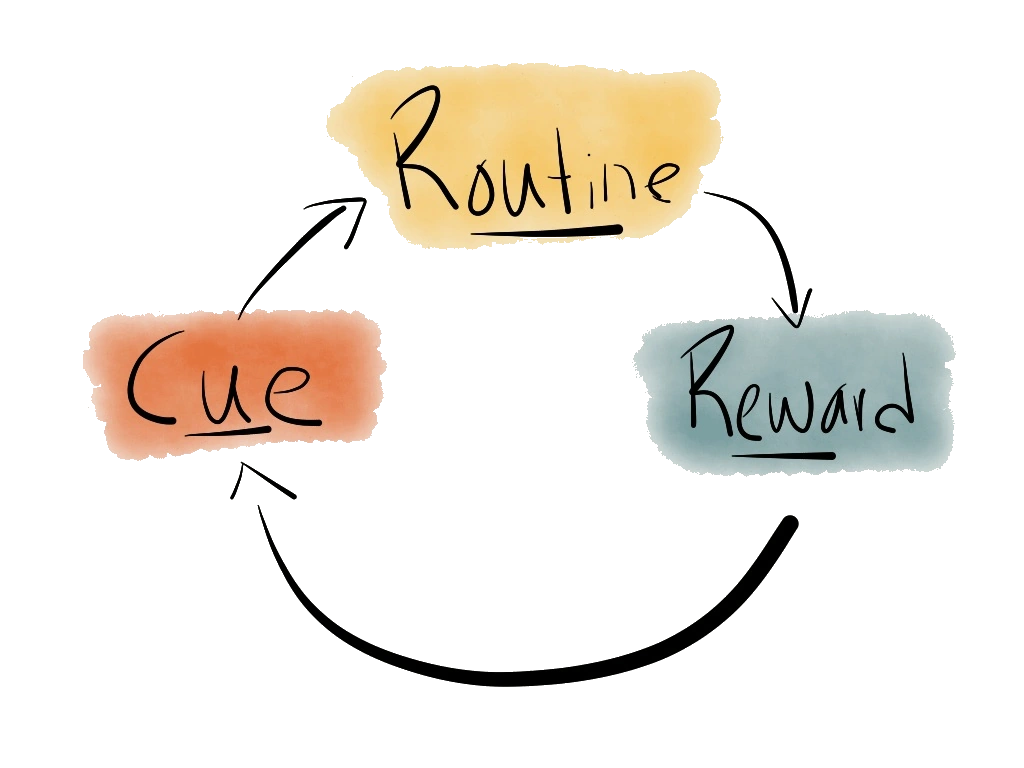
In his book The Power of Habit, Charles Duhigg explains something advertisers have known for quite some time: human beings can be trained to respond to cues with routines as long as there is a reward. He calls this the habit loop. It looks like this:

The idea is that when we have a cue, we usually will follow a certain routine that leads to a reward and if this cue occurs enough times it becomes a habit and is very difficult to break. Many habits have no particular reward but are still hard to break. Think about things Americans do not eat (cartilage, fat, and animal skin) that are good for you and if you do not eat these things, think about how gross it feels to try eating them.

Sola Scriptura

January 8, 2019

Edward Feser has three posts on the Protestant doctrine of sola scriptura (only the Bible) over at his blog.

Here is Feser's summary of a summary of the Jesuit critique of sola scriptura:

You’ll recall that the early Jesuit critique of sola scriptura cited by Feyerabend maintains that (a) scripture alone can never tell you what counts as scripture, (b) scripture alone cannot tell you how to interpret scripture, and (c) scripture alone cannot give us a procedure for deriving consequences from scripture, applying it to new circumstances, etc.

He was Going to Die Tomorrow

January 3, 2019

The Philokalia includes excerpts from Evagrius of Pontus’ Texts on Watchfulness. This one really caught my eye:

A monk should always act as if he was going to die tomorrow; yet he should treat his body as if it was going to live for many years. The first cuts off the inclination to listlessness, and makes the monk more diligent; the second keeps his body sound and his self control well balanced.
Now, meditating on death as a spiritual discipline is long attested in Scripture (Ecclesiastes 12:1-7) and other authors of antiquity, like Epictetus:
Day by day you must keep before your eyes death and exile and everything else that seems frightening, but most especially death; and then you’ll never harbour any mean thought, nor will you desire anything beyond due measure. (Enchiridion 21)
But what interested me in Evagrius' little note on watchfulness was his concern that the monk care for his body. We should live each day as though eternity awaits us on the other side, but we should care for our body as though we were going to live a long time. In the current year, it is apparently verboten to pursue physical ideals or attempt to establish them at all, but the fact is that insofar as it depends on us (for some bodily care is literally out of reach due to injury or congenital difficulties), the way we care for our bodies is reflective of and contributes to our spiritual well-being. Why? Because our body is our first bit of the earth to rule (Genesis 1:26-2:7) and because the state of our body directly affects our state of mind.
Bruce Charlton and John's Gospel

December 22, 2018

Over the past few months, Bruce Charlton has been reading John's Gospel exclusively in order to better understand the meaning of Jesus. He's come to some startling conclusions. He compiled them all here. In his final post reporting on this process, he made these observations:

I regard the Fourth Gospel as chronologically the first, and qualitatively the most authoritative, source on the life and teachings of Jesus. As I read and re-read, I found that the discipline created a situation as if the Fourth Gospel was the only scripture.

And indeed, whenever I turned to other Gospels, or to the Epistles and Revelation, they looked very much inferior; very much like rag-bag collections of theology, memoirs, theories and folk tales about Jesus; and of very mixed validity - since many things in them contradict the Fourth Gospel...

"Natural" Atheism

December 11, 2018

The ever-interesting Bruce Charlton explains why people are "naturally atheists."

The fact that all modern public discourse excludes the divine.

As a modern child grows up, he becomes socialised, he becomes trained in modern public discourse of many kinds: school work, everything to do with the mass media, sports, pastimes, hobbies... and all of these exclude the divine.

It Just Isn't There. The lexicon of objects that function in the system exclude the divine; the causality of the system excludes the divine.

As the child reaches adolescence - these modes of thought become more dominant, and they become habitual to the extent of being simply taken for granted; and eventually they become so habitual as to be extremely difficult to break out from.

This process is exacerbated in the world of work, where nearly all jobs exclude the divine (in whatever social system, the law, medicine, science, government, politics, police, the military, engineering - as well as the mass media and academia) - becoming competent means internalising these 'materialist' ways of thinking; thus, excluding the divine.

Ignatius' Rule of Spiritual Direction

November 25, 2018

The relational presupposition of Christian spiritual leadership, according to Ignatius of Loyola is this:

In order that both he who is giving the Spiritual Exercises, and he who is receiving them, may more help and benefit themselves, let it be presupposed that every good Christian is to be more ready to save his neighbor’s proposition than to condemn it. If he cannot save it, let him inquire how he means it; and if he means it badly, let him correct him with charity. If that is not enough, let him seek all the suitable means to bring him to mean it well, and save himself.

How is one justified?

November 13, 2018

It's a contentious issue to some. But I'll just post what the New Testament says without comment. Only one passage is partially my translation. The rest are either the NET or ESV. I've excluded passages that repeat the same thing. I have left one passage out about the impossibility of being justified by the law simply because I do not think that justification by law and justification by God for obeying the law are necessarily conceptual equals. But it's important to consider that the New Testament picture of justification is rich and a simple formulation of how it happens is by no means obvious.

The Christian Hope and Homo Prospectus

September 5, 2018

The Christian version of the afterlife is unique in two respects. It is so unlike our present existence that the Bible says that it can only be seen dimly and is best expressed in images. But it is very much like our present existence in that our present self will be preserved and will have attributes and levels of flourishing which depend upon our virtue in this life.

Jordan Peterson: Heretic or Helpful Pagan?

February 20, 2018

Rachel Fulton Brown writes:

...I don’t think that Jordan has a Messiah complex. But I do think that he thinks that he is capable on the strength of his own will of saving the world. It is why he spends so much time speaking. Because he believes that through his speech he can save himself—and that by speaking in the way that he does, he can save everyone. Sure, Jordan uses Christian vocabulary, but he does not think like a Christian, nor does he claim to.* Rather, Jordan thinks like Nietzsche, as he shows clearly in his book.