Geoff's Miscellany

Uncategorized

Linkin Park, Chester Bennington, and Death

August 13, 2017

A few weeks ago Chester Bennington, the front-man for the genre bending group, Linkin Park died, apparently having committed suicide.

When I was in high school I really loved every song but one on their first two albums Hybrid Theory and Meteora. And in those days of music pirating software like Kazaa and Morpheus, I was able to discover older versions of hits like In The End with significantly superior lyrics that may not have been as interesting to a mass market audience.

How to get your life together: James

August 12, 2017

Get it together

I’ve been doing Sunday school lessons on the book of James for weeks and while it has specific social applications to the struggles faced in his day, I'd say the main message is something like this: You have heard the word, accepted the word, and joined a church founded on the word, get it together!

Here’s what I found:

  1. Own your trials (James 1:2-4 and 1:13-15)
  2. Pray for wisdom before rescue (James 1:5-8 and James 5:13)
    James says to pray in the midst of trials for wisdom. This is powerful because our first instinct is to pray for difficult times to end. And James does endorse this notion at the end of the book. But it seems that prior to praying for God to miracle us out of a rough patch, James says to pray for wisdom. This is connected, I think, to two things. One is that most of us know what will solve our problems because we’ve heard wisdom and we have a conscience. And so, to ask for it from God reorders our minds to make us perceptive to what might already be present in us. But also, we’re asking God to give us genuine insight that we may not currently have to solve the problems that we’re facing. This is directly connected to owning our trials. James also says that if you ask insincerely or with a double mind, you won’t get wisdom. What does this mean? It means that if you ask for help out of your trial without a willingness to perhaps let go of the parts of your life that are causing you problems, you will not benefit from the prayer.
  3. Submit to the highest good you can imagine (James 1:17 and James 4:7)
    Saint Anselm defined God as the being which is the highest being that could be conceived. And so, whatever the highest ideal we have in our minds is, that is, subjectively speaking, our God. And then God is, objectively infinitely more true, good, and beautiful than that. And so James is saying that God is the source of all goodness and to submit yourself to God. Many of us willingly do things in a manner that does not reflect God himself or his goodness and even more so, we do not even do things in a manner that reflects our own highest conception of the good. And James says that we need to get that straight.
  4. Judge yourself, then act (James 1:21-25, James 2:14-26, and James 3:13-18)
    James then tells us that God’s moral law, contained in Scripture, is the standard by which we must judge ourselves just as we judge ourselves in a mirror. This reflection upon Scripture is meant to give us a picture of how shabby we are morally so that we can shave, shower, comb our hair, and straighten out our clothes. It’s not enough to believe that God’s law is good. And it’s actually worse to believe God’s law and use it to simply judge how bad others are. Instead, we have to believe God and do what he says is best, and “it will be accounted” as righteousness to us. James also paints a picture of the worst possible version of yourself and the best possible version of yourself in 3:13-18. The idea is to simultaneously give you a future so horrifying that you run from it like hell, literally, and a future so beautiful and enthralling that you seek it like a river of pleasures and heavenly joy (Psalm 36:8 and Psalm 46:4).
  5. Let Jesus define your vision of glory (James 2:1)
    James briefly mentions that Jesus is the Lord of Glory. For Christians and maybe for any non-Christian in Western Civilization, it’s deeply important that we fully imbibe the story of Jesus in its details, broad strokes, and multiple layers of meaning. And James is telling the early Christians that the Christian faith is a faith that doesn’t reject the concept of glory, but a faith that defines glory as “whatever Jesus is.” Learning to see Jesus as the wise Lord with true teachings, the prototype of perfect humanity, an archetypal figure whose journey through chaos can be a picture of our own, the lamb who takes away the sins of the world, the second person of the Godhead, the way the truth and the life, the resurrected master of the cosmos, and so-on goes a long way in our efforts to sort out our lives.
  6. Start with the little things: the tongue (James 3:2)
    James says that getting our lives together requires taking control of what we say. But the claim seems to be but one expression of a deeper Biblical truth, that if we’re faithful in small matters, God will see to it that we have authority in larger ones (Luke 16:10). The idea is that if you can take responsibility for your tongue, then you’ll learn to control the other habits of your body. Similarly, if you can clean your room or your car, then maybe you’ll start having a better picture of how to clean your heart or your relationships at work or in your home.
  7. Let sorrow make you good (James 4:8-9)
    Sometimes, our circumstances cause us deep deep sorrow. James helps us to see the value of sorrow by encouraging it, despite the fact that earlier in the letter he commends joy in the most trying of times. How can both be true? First, many of our sorrows are our own fault. Not all, but many. If we look to them and weep as he suggests, then we may have insight into what we need to do to cleanse our hearts. "Cleansing your heart" is a biblical way of saying, "Get it together!" Second, sometimes our joy is false and we can only learn that we should be sad if we draw near to God and discover how tattered we are due to sins to which we’ve made a commitment which rivals our commitment to God.
  8. Virtue outlasts your achievements (James 2:5, James 4:14, and James 1:9-11)
    The highest form of success we can have is to be virtuous when we die. This idea is stoic but it’s also Biblical. Happiness as a state of life includes more than mere virtue, as the Bible speaks of a life with more goods than mere virtue (see Proverbs). But you cannot always control your possessions, family, and the local economy, but you can control your actions.
  9. Resist the devil daily (James 4:7)
    Assume that Satan is the god of the earth (2 Corinthians 4:4). This means that our culture, which shapes our desires, is probably filled with bad ideas, bad habits, false knowledge, counterfeit gospels, and fake news. Not only so, but you’re a product of your culture. So, you’re full of those things, too. So to resist the devil is to resist (or re-aim) the darkest parts of yourself toward the good and to resist the temptations of civilization to stifle truth-telling, creativity, love, service, or moral purity. And the devil, in the senses above is without and within. Good luck.
  10. Sacrifice your plans to God (James 4:13-15)
    The Bible is for planning. But it’s against holding on to plans in an arrogant way. James says to say, “if God wills we will do ‘this or that.’” The idea isn’t to superstitiously say that. In James, the word “say” reflects your intentions. And so what James is getting at is that at any moment, our best plans for the future must be subject to revision based on our understanding of the will of God. The Old Testament sacrifices are a good metaphor for this. You might have a prized lamb and it is the best possible thing your crops produce, but instead of basing your whole life on that, you must be willing, should the need arise, to sacrifice it to God. In doing this you can sort yourself out when it comes to your competent plans for the future and the level of frustration you're willing to experience if those plans betray you.
  11. To Be Honorable Be Humble (James 4:6 and James 4:10)
    Most people want to be honored, but few even consider that you might receive honor from the highest possible good (God). And yet, this is precisely what James says. And if we make honor itself the highest good, we’ll find ourselves doing things we regret deeply because we’ll do what the world around us tells us to do without reference to conscience, the truth, or our own intuition.[1] But if instead we think in terms of a covenant or contract with God wherein he promises to make those who humble themselves great by his standards, then we’re not constrained by culture except in the sense Paul talks about in Romans when he said to think about “what is honorable in the sight of all” (Romans 12:17).
  12. Learn to save a brother without judging (James 4:11-12 and James 5:19-20)
    James also tells us that our social lives need organizing. And of course, that’s included in he says about the tongue, doing the will of God, planning our future, and judging ourselves. But a large part of it is learning to avoid having a condemnatory attitude toward others. I think that this is done by seeing ourselves as in need of judging first. This is a principle James outlines in chapters one and two. And Jesus certainly says as much in Matthew 7:1-5. But after judging ourselves and seeing the depth of darkness in our own hearts, we are now competent to observe the evil in others. And if we see it we can guard against evil people, which James talks about in James 2:6-7 and James 5:1-6. But we also have the power to gently correct those who are sinning. And I think we can do this by talking about our own struggle with sin and what was necessary to overcome. But we can also do it by warning as sternly or gently as circumstances warrant from the position of a loving family member rather than condemning judge.

I frequently feel the need to finish a Bible study with “so there” or “take that.” Instead, I’ll just say, “any thoughts?”

Journalism: A lost art?

August 11, 2017

I was looking up some of Will Gervais’ recent work on atheism (has in the past published on why even atheists dislike athiests, heh).

One of the articles that popped up was a salon article about his recent work about the apparent prevalence of atheism in the United States. In the final paragraph the author remarked that, about Trump:

As with his other attempts to turn back the clock in America, President Trump’s remark in his inaugural address about joining all Americans together with “the same almighty Creator,” threatens the intricate and varying histories, beliefs and ways of being that are present in this country.
But Trump is a guy who, if ever, only took an interest in God very recently and has made no moves toward a theocracy in any policy.

The article had an awesome title portending the rise of hidden atheists within evangelicalism, “Trump Evangelicals face a growing number of ‘hidden atheists.’” I had hoped for an article about atheists going to church or something (of course this was Solong magazine).

Genesis 1-2 and Man as Artist

July 29, 2017

One of the ideas that emerges from the first two chapters of Genesis is the distinction between creation and cultivation, nature and art, or even chaos and order.

For instance, when God makes the world it is a chaotic emptiness (Genesis 1:1-2), but through the next several verses, he organizes it into a series of useful categories. Then he makes humanity, explaining that not only would they reproduce and eat, like the other creatures, but that they would be blessed, take dominion, and bear the image of God. So man is to subdue (or cultivate in context) the created world.

The Imaginary Amendment

July 28, 2017

Last election season as morally and emotionally exhausting for many.

I thought it was pretty funny.

One of the most intriguing aspects of the whole thing was that in the space of about one year, the notion of purely open borders or even more to the point, the notion that the whole planet had a right to live within the boundaries of the United States of America became a frequent implication of talking points on the right and left.

Science "Disproves" the Bible Again

July 28, 2017

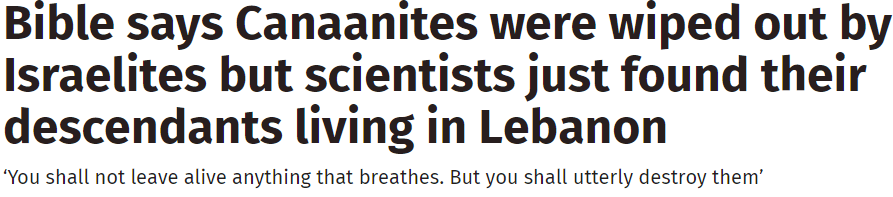
In a goofy clickbait article, Ian Johnston claims that (btw, it’s helpful to use webarchive to link articles like this so that they don’t get ad revenue):

Independent Article very bad.PNG

The argument goes:

  1. The Bible reported that the Israelites were supposed to annihilate the Canaanites.
  2.  If true, "the Canaanites could not have directly contributed genetically to present-day populations."
  3. Canaanite DNA has been in the Lebanese population.
  4. Therefore, the Bible is false.
Hilariously, the author points out that:
While the Bible says they were wiped out by the Israelites under Joshua in the land of Canaan, later passages suggest there were at least a few survivors. Some Biblical scholars have argued the passages are hyperbole, but the genetic research would appear to indicate the slaughter was much less extensive than described.
"The text uses hyperbole...but science says that the text is exaggerating."

Religious people of all stripes will stop hating scientists or their goofy popularizers in famous online blogs when they stop being disingenuous blobs. I have nothing against disingenuous blobs. It’s an honest living, after all. I’m merely pointing out that others do.

Human Sex Differences

July 10, 2017

Last night at a Bible study the question of sex differences came up. Specifically, we discussed whether there were traits/virtues that were either feminine or masculine in the Bible.

The consensus was yes, but upon being asked to give specifics, only my wife and I named anything other than the special bond of motherhood.

I named courage in battle as a prototypical masculine trait. She named a quiet and gentle spirit as a feminine trait I don't think anybody thought what we said was accurate. But for clarity, from a Biblical point of view, the virtues in Scripture are for every person and from a philosophical point of view, justice, courage, temperance, and prudence and for both sexes as well. But with that background, the question is this, does the Bible praise certain traits as particularly masculine/feminine (despite their being virtues for all)? And does the Bible condemn certain traits in one sex more than another? Those two questions, if the Bible does either or both of those things, might yield a picture of what traits/virtues/vices are masculine and feminine. With respect to having a quiet spirit, while 1 Peter 3:1-4 extols this traits with respect to a wife's relationship to her husband, the Bible portrays it as a general virtue for all humanity in Psalm 131 and in 1 Peter 2, Peter attributes a quiet spirit to Jesus.
It's Everybody's Job

June 10, 2017

I try to stay off Twitter except for brief times I'll allow myself to play on it a few days in a row. The temptation to troll is too great for me and the medium has become less fun as people only tend to interact with you if you're famous or to humiliate you. But I do follw a few feeds as a part of my morning reading. Geoffrey Miller, author of Spent: Sex, Evolution and Consumer Behavior and The Mating Mind: How Sexual Choice Shaped the Evolution of Human Nature is an entertaining and informative part of that ritual. A few days weeks back he produced this tweet:

Science fact of the day: No such thing as healthy obesity

May 17, 2017

While I have my questions about the BMI scale and its ability to predict health for those with low body-fat percentages, it has proven a remarkable predictor of health in the general population (low body-fat people are rare in the United States, after all).

Anyway, in a study published in 2016, the authors concluded that:

Low aerobic fitness in late adolescence is associated with an increased risk of early death. Furthermore, the risk of early death was higher in fit obese individuals than in unfit normal-weight individuals.
Now, this study doesn't distinguish between "fit obese" individuals who are obese because of muscle mass above average and individuals with a high body fat percentage who happen to be good at aerobics.

Good Charlotte Was Right: A Science Fact of the Day

March 4, 2017

I haven’t done a science fact of the day lately. Work is time consuming. Don’t forget, science facts of the day are my thoughts on and descriptions of what scientists say. In other words, it’s a fact that some scientists have said it. What I write is not necessarily a fact of nature nor something I even take to be the case.

In an article at Big Think, an author describes this analysis of online dating data.