Geoff's Miscellany

Posts

Genesis 1-2 and Man as Artist

July 29, 2017

One of the ideas that emerges from the first two chapters of Genesis is the distinction between creation and cultivation, nature and art, or even chaos and order.

For instance, when God makes the world it is a chaotic emptiness (Genesis 1:1-2), but through the next several verses, he organizes it into a series of useful categories. Then he makes humanity, explaining that not only would they reproduce and eat, like the other creatures, but that they would be blessed, take dominion, and bear the image of God. So man is to subdue (or cultivate in context) the created world.

The Imaginary Amendment

July 28, 2017

Last election season as morally and emotionally exhausting for many.

I thought it was pretty funny.

One of the most intriguing aspects of the whole thing was that in the space of about one year, the notion of purely open borders or even more to the point, the notion that the whole planet had a right to live within the boundaries of the United States of America became a frequent implication of talking points on the right and left.

Science "Disproves" the Bible Again

July 28, 2017

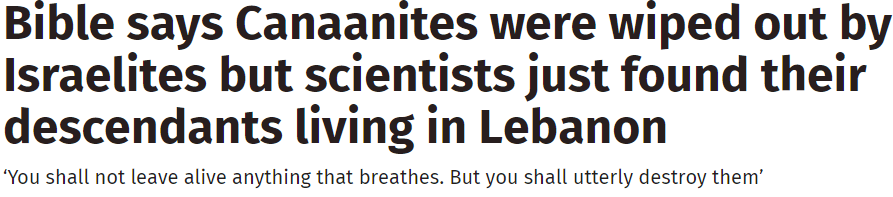
In a goofy clickbait article, Ian Johnston claims that (btw, it’s helpful to use webarchive to link articles like this so that they don’t get ad revenue):

Independent Article very bad.PNG

The argument goes:

  1. The Bible reported that the Israelites were supposed to annihilate the Canaanites.
  2.  If true, "the Canaanites could not have directly contributed genetically to present-day populations."
  3. Canaanite DNA has been in the Lebanese population.
  4. Therefore, the Bible is false.
Hilariously, the author points out that:
While the Bible says they were wiped out by the Israelites under Joshua in the land of Canaan, later passages suggest there were at least a few survivors. Some Biblical scholars have argued the passages are hyperbole, but the genetic research would appear to indicate the slaughter was much less extensive than described.
"The text uses hyperbole...but science says that the text is exaggerating."

Religious people of all stripes will stop hating scientists or their goofy popularizers in famous online blogs when they stop being disingenuous blobs. I have nothing against disingenuous blobs. It’s an honest living, after all. I’m merely pointing out that others do.

The only word for this: heh

July 27, 2017

Here is what happens when you believe that ultimate reality is class-conflict between men and women:

https://www.youtube.com/watch?v=IFb_AERKha8&w=560&h=315

You have to subvert truth to believe that worldview because it is observably true that cooperation between the sexes makes new humans.

You have to subvert goodness to believe that worldview because one must assume that any apparent good is a tool of oppression.

The Mindset of the Spirit and the Mindset of the Flesh

July 27, 2017

Since becoming a teacher, I’ve been utterly intrigued by Carol Dweck’s concept of mindset. What’s interested me most is where the idea appears in Scripture. The most obvious part of the Bible is in Romans 8:

For those who live according to the flesh set their minds on the things of the flesh, but those who live according to the Spirit set their minds on the things of the Spirit. To set the mind on the flesh is death, but to set the mind on the Spirit is life and peace. For the mind that is set on the flesh is hostile to God; it does not submit to God’s law, indeed it cannot; and those who are in the flesh cannot please God.[1]
The more literal translation of “to set the mind on the Spirit” is “the mindset of the Spirit,” or perhaps “the mentality/outlook of the Spirit.” The concept is something like, “the way of managing one’s mind which starts with “setting the mind on the things from the Spirit” from verse six. In other words, it’s the total of beliefs, attitudes, and thought processes that a Christian uses to be transformed by the renewal of the mind (Romans 12:1-2).

But what is this mindset? What are the beliefs, attitudes, and thought processes that Paul means? And beyond that, what are the beliefs, attitudes, and thought processes provided by the Holy Spirit outside of Paul’s immediate reference? I propose a three-step way forward:

Brief Reflection on Christianity and Politics

July 27, 2017

I can think of two main errors made about the relationship between the gospel and politics. Each of them has multiple instantiations:

Over-Absolutizing Politics

In this case, Christians see that the gospel has specific political implications and then associate those implications with the gospel itself. 

Over-Relativizing Politics

In this case, Christians see that the gospel is central and supreme and therefore ignore domains, ideas, and policies not central to the gospel.
Both of these happen on the theological and political right and left. 

I think the relative importance of politics, in comparison to the gospel, does make non-participation necessary for some people (like some had to sell all their possessions in the gospels). Similarly, I think that the fact that there are right and wrong political positions, or at least right or wrong political aims means that Christians, generally, ought to care about politics to love their neighbor and see to the well-being of their children and grandchildren. 

Conservatism Conserves What?

July 18, 2017

This is an edit of a post from October 21st, 2016
When I was in junior high I learned about conservatives and liberals.
I was really confused about the fact that liberals wanted more rules for business owners and that conservatives wanted to spend more money on war.
A couple of years later, I converted to Christianity and found several conservative political positions to line up with my emerging moral consciousness. But, I also found several of them to abhorrent.
  1. Pro-life made sense. Abortion is the most insane inversion of the order nature I could and can imagine.
  2. I thought prison sentences for most crimes made no sense.
  3. Keeping the government mostly out of the market made sense (though I was skeptical of conservative opposition to minimum wage increases and I thought tariffs made sense)
  4. I also thought that going to war all of the time seemed to be a "liberal" use of money.

My Skepticism Rose

During Bush the Younger's presidency, I remembered thinking that the privacy intrusions of the intelligence agencies, the quickness with which we went to war with Iraq over 9/11? WMDs? oil? (how and why was that wise?) and the reticence to do anything about abortion showed that conservatives meant [based on observing their actions] neither to conserve human life in general, American lives, nor the constitution.
Now that I've realized how little conservatives care to conserve. I tend to think that Republicans don't actually want to win the pro-life argument at the legal level because then they couldn't use the platform to get elected.

The Five Stages of Conservative

Ed Feser expertly mocked the conservative way of being in the world here:
  1. Stage 1: “Mark my words: if the extreme left had its way, they’d foist X upon us! These nutjobs must be opposed at all costs.”
  2. Stage 2: “Omigosh, now even thoughtful, mainstream liberals favor X! Fortunately, it’s political suicide.”
  3. Stage 3: “X now exists in 45 out of 50 states. Fellow conservatives, we need to learn how to adjust to this grim new reality.”
  4. Stage 4: “X isn’t so bad, really, when you think about it. And you know, sometimes change is good. Consider slavery…”
  5. Stage 5: “Hey, I was always in favor of X! You must have me confused with a [paleocon, theocon, Bible thumper, etc.]. But everyone knows that mainstream conservatism has nothing to do with those nutjobs…
Stage five describes contemporary conservatives thoroughly.

Christians do this, too.

Conserving a theory of human nature

July 17, 2017

The conservatives in the Anglican church have run into trouble conserving a basic distinction fundamental to the Biblical narrative, having a family, the continuing of the church as a community in history, and the building and maintenance of civilization. The BBC reports that:

The Church of England's governing body has voted to look into special services for transgender people.

Now, they haven't voted, as far as I know, to have those services. But they've voted to look into it and this is how conservatives end up defending the values of the liberals of twenty years prior every. single. time.

The services, I predict, will be approved. Then they will be used as an excuse to move toward marriage between people with gender dysphoria. After that, sexual libertinism will be the norm. In fact, I predict that the only sexual sin in many mainline Christian churches in 20 years will be the sin of calling divorce a sin.

Eating Meat is good for the environment?

July 17, 2017

I mean, of course it is. Farming animals requires ecosystem maintenance, whereas vegetation farming on mega farms is simply a process of ecosystem alteration through a process of chemical fertilizing, mass pesticide promulgation, and government subsidizing of non-ideal plants in regions hostile to their growth. Dr. Eades, over at protein power has a great post about this:

Human herding mimics the ‘herding’ done by large predators in the wild. That replicating natural herding creates the richest soil makes sense given that grasslands, large herbivores, and carnivores all co-evolved. Just as with diet, the closer we come to what the forces of natural selection designed us to eat, the better things work.
Here's a Ted talk he posted about it by Allan Savory:

What is a good person?

July 17, 2017

Dallas Willard defines a morally good person:

The morally good person is a person who is devoted to advancing the various goods of human life with which they are effectively in contact, in a manner that respects their relative degrees of importance and the extent to which the actions of the person in question can actually promote the existence and maintenance of those goods. Thus, moral goodness is a matter of the organization of the human will called "character."
This is a serviceable definition. It is a few words away from a definition of a mature Christian. I would alter it this way to make it Christ-centered:
The mature Christian is a person who is devoted to advancing the various goods of human life with which they are effectively in contact, in a manner that respects their relative degrees of importance and the extent to which the actions of the person in question can actually promote the existence and maintenance of those goods. The mature Christian recognizes that Jesus Christ's teachings are the surest guide to the relative degrees of importance of those goods, especially Jesus' focus on the kingdom of God and the righteousness thereof. They understand that God is the highest good and source of all good in the world, including any good in themselves. They also see that at any moment may reject the good and are therefore themselves in need of constant repentance and are necessarily in need of forgiveness and atonement. By treating Jesus' words as the foundation of their lives, they thereby rely on God's Spirit and receive transforming help from God himself. 
Willard also describes the morally bad person:
The person who is morally bad or evil is one who is intent upon the destruction of the various goods of human life with which they are effectively in contact, or who is indifferent to the existence and maintenance of those goods.
Of course, this is the person who is like Cain. Cain sees his brother Abel, wishes to have God's approval just like him, and instead of sacrificing his own behavior and desires to achieve his ideal (to be like Abel) he slaughters his ideal. The morally bad person is similar. It's not that they literally pursue evil. It's that they take imprudent shortcuts to the good that destroy the good in the process or they pursue penultimate goods as the ultimate good (idolatry). Of course, the mature Christian sees the potential to become this person residing in their heart at all times. In fact, even an innocent person who has never sinned has the potential to become evil (see the Adam and Eve story).

Anything I’ve left out?