Geoff's Miscellany

Posts

The Bible and Self-Knowledge

December 31, 2016

The Socratic ideal of self-knowledge is hard to come by, but it can be done. We are often apt to give up when we find unpleasing information about ourselves or we can deceive ourselves. The Bible gives some philosophical tools to help you find this rare form of knowledge. 

Here are five resources from the Bible to help you overcome self-ignorance and gain self-knowledge:

  1. Critique yourself as harshly as you feel tempted to critique others. Matthew 7:1-5 ESV “Judge not, that you be not judged. (2) For with the judgment you pronounce you will be judged, and with the measure you use it will be measured to you. (3) Why do you see the speck that is in your brother's eye, but do not notice the log that is in your own eye? (4) Or how can you say to your brother, ‘Let me take the speck out of your eye,’ when there is the log in your own eye? (5) You hypocrite, first take the log out of your own eye, and then you will see clearly to take the speck out of your brother's eye.
  2. Do a thought experiment and judge your life as though you were keeping watch on accurate teaching. Does your life measure up? You’ll find your flaws and virtues very quickly this way. You could also imagine that you are a pastor and that somebody who is just like you came to you for advice. What would you need to know about them to help them overcome their sins, bad habits, and folly in general? 1 Timothy 4:16 ESV Keep a close watch on yourself and on the teaching. Persist in this, for by so doing you will save both yourself and your hearers.
  3. Compare yourself to the ideals contained in the word of God, especially Jesus. 1 John 3:2-3 ESV Beloved, we are God's children now, and what we will be has not yet appeared; but we know that when he appears we shall be like him, because we shall see him as he is. (3) And everyone who thus hopes in him purifies himself as he is pure.
  4. Compare yourself to the ideals in the world around you. Proverbs 13:20 ESV Whoever walks with the wise becomes wise, but the companion of fools will suffer harm.
  5. Invite Criticism from Others Proverbs 24:5-6 ESV A wise man is full of strength, and a man of knowledge enhances his might, (6) for by wise guidance you can wage your war, and in abundance of counselors there is victory.
The Three Value Systems and Their Mindsets

December 28, 2016

Here is a rough sketch of three value systems and the three mindsets that seem to correlate with them. These value sets aren’t meant to be seen as ideological. But rather, values observed in practice. So they don’t necessarily go with specific ethical conclusions like “abortion is good” or “polluting is bad.” These are the ‘in practice’ values that people utilize to manage their lives. Because these clusters of values can be held by people of varying degrees of moral insight, they aren’t necessarily good or bad. They just identify how we operate. Some of the items here have moral consequences or underpinnings, but I’m not trying to talk about the moral value or individuals who operate in these ways. I’m just trying to categorize things practically. So these are the sorts of ideals that people consciously or unconsciously pursue and find ‘motivating.’

N.N. Taleb on Inequality and Skin in the Game

December 28, 2016

N.N. Taleb writes:

Again, on that account, the detractors of Donald Trump, when he was a candidate, failed to realize that, by advertising his episode of bankruptcy and his personal losses of close to a billion dollars, they removed the resentment (the second type of inequality) one may have towards him. There is something respectable in losing a billion dollars, provided it is your own money.
I think that this is one among many factors that the media missed in their coverage of the 2015-2016 presidential race.

Thomas Sowell once said that, “It is hard to imagine a more stupid or more dangerous way of making decisions than by putting those decisions in the hands of people who pay no price for being wrong.” He was speaking about the school system, but this is a sort of categorically imperative principle for management, leadership, and so-on. And Taleb gives the example of university professors that wait until they have tenure to start saying wildly incorrect things that influence the world negatively and yet they are in no danger of losing their pay-checks.

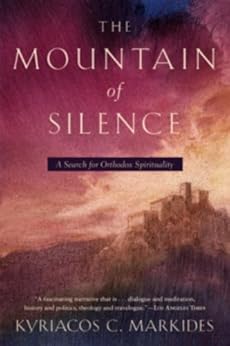
Book Review: The Mountain of Silence by K. Markides

December 22, 2016

Kyriacos C Markides, The Mountain of Silence: A Search for Orthodox Spirituality (New York: Doubleday, 2001).

Kyriacos Markides, a professor of sociology, spent several years studying mysticism and shamanistic practices in several monastic type communities. He’s written several books on these topics, this particular book is about his experiences with Father Maximos on Mt. Athos.

This book was recommended to me by O_Vivliothikarios on Twitter.

Guard Your Heart: How?

December 20, 2016

Pro 4:23 Guard your heart with all diligence, for from it flow the springs of life.
What does it mean to guard your heart?

In your Bible, ‘heart’ tends to mean the seat of reason or the human will.[1] In our world we’re so influenced by the romantic nature poetry of the 1800s, it’s easy for us to assume that the Biblical authors are speaking about our authentic feelings when they use the word heart. But in general, they mean the will and/or the reason. That being said, what does ‘guard your heart’ mean? The first guide should be the meaning of heart and the meaning of guard. Here are some suggestions just from those word meanings:

Growth in Grace: Transformation of the Feelings

December 20, 2016

Introduction

Over time, our response to God’s grace will lead to a transformation of our feelings and emotions.

This is evident from two perspectives. First, from observation, we know that part of a long-term diet plan includes learning to like different foods. If this change does not take place, then evidence shows that people tend to end up heavier than they were before going on a diet. Secondly, from Scripture, we see that the ideal Christian life includes the experience of appropriate positive emotions regarding God, truth, goodness, and beauty and negative emotions regarding evil, sin, suffering, and so-on.[1]

Book Review Pt 1: The Four Loves by C.S. Lewis

December 20, 2016

This is part one of a multi-part review of The Four Loves by C.S. Lewis.

The Four Loves: Introduction

Lewis, Clive Staples. The Four Loves. London: Fontana, 1964.

In Lewis’ book on the kinds and nature of love he starts the book by distinguishing between Need-love (like a small child for its mother) and Gift-love (like a man working to leave a legacy for his family which he may never see). Lewis had hoped to write the whole book based on this distinction saying essentially that Need-love is bad and Gift-love is good and Christian. What he found, though, was that this is impossible (7).

The Christian Life: Positional and Progressive Elements

December 20, 2016

Intro

In kinesiology class back in college, I had a professor tell me that since the triceps muscles functioned to extend the forearm, one only needed to do bicep curls to exercise the whole arm. Her reasoning was that lowering the weight extended the forearm, and therefore exercised the triceps. She had taken a basic fact and misapplied it because she neglected to account for simple facts like gravity being the force that lowers the weight as the lifter slowly relaxes his biceps.

Similarly, in the Christian life, we can easily misapply things. This is especially so in the case of the Bible’s language regarding Christian growth and God’s grace. For instance, some see the passages about justification by grace through faith is the ultimate or only expression of the Christian life. In so doing, they can actually believe/explain a version of faith that does not lead to good works or obedience in Christ. In fact, some might even disparage good works!

Biblical Mindset

December 14, 2016

One of the great casualties of modern academic theology and biblical studies is any sense that the Bible offers a philosophy for life. And I don’t just mean that it provides information for the creation of an accurate worldview or political practice. I mean that the Bible offers actual insight into the realities of human nature (mind, body, spirit/soul), history, and God. But I think that the Bible claims to offer such a philosophy. A brief example can be found here:

Parents as gods

December 13, 2016

Being a parent is hard work. Being a dad has its own unique challenges. I have no doubt that it will be one of my greatest challenges.

Two of my favorite quotes, one about being a mother and the other of being a father, come from quite unlikely sources, two different satires: Fight Club and Vanity Fair.

"Mother is the name for God in the lips and hearts of little children..." - Vanity Fair 

He says, “What you have to understand, is your father was your model for God.”…The mechanic says, “If you’re male and you’re Christian and living in America, your father is your model for God. And if you never know your father, if your father bails out or dies or is never at home, what do you believe about God?” “What you end up doing,” the mechanic says, “is you spend your life searching for a father and God.” “What you have to consider,” he says, “is the possibility that God doesn’t like you. Could be, God hates us. This is not the worst thing that can happen.” How Tyler saw it was that getting God’s attention for being bad was better than getting no attention at all. Maybe because God’s hate better than His indifference. If you could be either God’s worst enemy or nothing, which would you choose? - Fight Club 

For the Christian, the parents are the models for God. Many people spend their whole lives unlearning the image of God they constructed in their youth based on their parents.