Geoff's Miscellany

Posts

Water from the Desert: Evagrius of Pontus

January 10, 2019

  1. Evagrius was a desert monk who lived from 345-399. He was well known for his academic abilities and was frequently sought after for his wisdom but fled the life of popular acclaim upon being tempted to have an affair (think Joseph and Potiphar’s wife).
  2. An anonymous history, Historia Monachorum testifies of him, “We also visited Evagrius, a wise and learned man who was skilled in the discernment of thoughts, an ability he had acquired by experience. He often went down to Alexandria and refuted the pagan philosophers in disputations...He taught us much else about ascesis, strengthening our souls.” His work was described as “training his intellect to examine his thoughts systematically (Palladius’ Coptic Life). This “thinking about thinking” was seen as a direct continuation of Jesus’ command to repent, because the Greek word behind it means, “rethink your thoughts.”
  3. Evagrius’ Core ideas (In his book, “153 sayings on Prayer):
    1. He would often use the word “demons” for bad thoughts.
    2. The pursuit of the good (especially spiritual prayer) is hindered by the passions: “What is it that the demons wish to excite in us? Gluttony, unchastity, avarice, anger, rancor, and the rest of the passions, so that the intellect grows coarse and cannot pray as it ought. For when the passions are aroused in the non-rational part of our nature, they do not allow the intellect to function properly.”
    3. “When the demons see you truly eager to pray, they suggest an imaginary need for various things, and then stir up your remembrance of these things, inciting the intellect to go after them; and when it fails to find them, it becomes very depressed and miserable.”
      1. This is analogous to your experience sitting down to do homework or deciding to clean your room, or resolving to exercise, etc.
    4. What is spiritual prayer? “Whether you pray with brethren or alone, try to pray not simply as a routine, but with conscious awareness of your prayer. Conscious awareness of prayer is concentration accompanied by reverence, compunction and distress of soul as it confesses its sins with inward sorrow.
    5. How does one dispell the passions and distracting thoughts which stir them up? “He who has mastery over his incensive power has mastery also over the demons. (Discrimination of Passions and Thoughts)”
    6. Finally, here’s his thought on how the Christian interested in daily growing in Christlikeness ought to live, “A monk should always act as if he was going to die tomorrow; yet he should treat his body as if it was going to live for many years. The first cuts off the inclination to listlessness, and makes the monk more diligent; the second keeps his body sound and his self control well balanced” (Texts on Watchfulness).

Sanctification, Repentance, and the Habit Loop

January 10, 2019

Introduction to Concept:

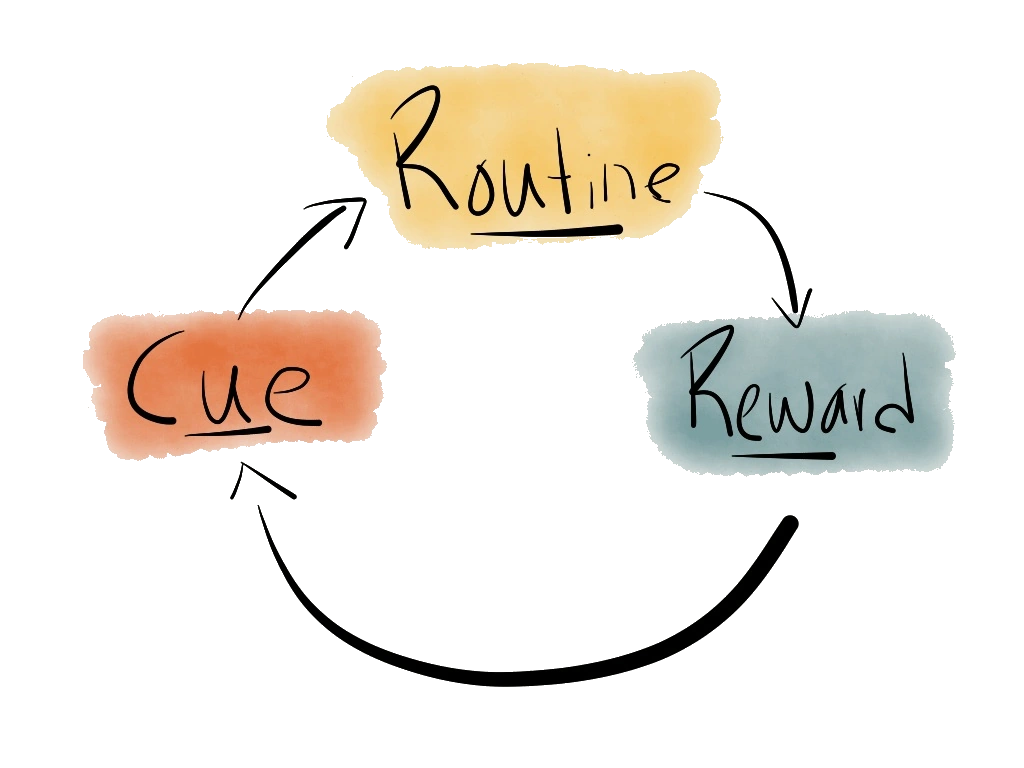
In his book The Power of Habit, Charles Duhigg explains something advertisers have known for quite some time: human beings can be trained to respond to cues with routines as long as there is a reward. He calls this the habit loop. It looks like this:

The idea is that when we have a cue, we usually will follow a certain routine that leads to a reward and if this cue occurs enough times it becomes a habit and is very difficult to break. Many habits have no particular reward but are still hard to break. Think about things Americans do not eat (cartilage, fat, and animal skin) that are good for you and if you do not eat these things, think about how gross it feels to try eating them.

Science Fact of the Day: Pregnancy and Strength Training

January 9, 2019

When I was a personal trainer I had always hypothesized that strength training would lead to positive outcomes for pregnant women and the child, particularly if they had been training prior to the conception of their child.

Since I'm not a research center and such training could be high risk, I just wouldn't train a pregnant woman. The wisdom in the early 2000s was, "don't engage in strength training if you're pregnant." Among trainers the wisdom was, "that doesn't make any sense, but don't do it to avoid a lawsuit."

Sola Scriptura

January 8, 2019

Edward Feser has three posts on the Protestant doctrine of sola scriptura (only the Bible) over at his blog.

Here is Feser's summary of a summary of the Jesuit critique of sola scriptura:

You’ll recall that the early Jesuit critique of sola scriptura cited by Feyerabend maintains that (a) scripture alone can never tell you what counts as scripture, (b) scripture alone cannot tell you how to interpret scripture, and (c) scripture alone cannot give us a procedure for deriving consequences from scripture, applying it to new circumstances, etc.

The Four Ps of Manliness

January 7, 2019

Brett Mckay over at The Art of Manliness wrote a post a few years back about the three Ps of manliness (a part of a very good series):

  1. Procreate
  2. Provide
  3. Protect

But I think there's a fourth P that has to go along with each of these. I'm not sure what word to use, maybe Progress, Paradigm, or Personify (to make it a verb).

He was Going to Die Tomorrow

January 3, 2019

The Philokalia includes excerpts from Evagrius of Pontus’ Texts on Watchfulness. This one really caught my eye:

A monk should always act as if he was going to die tomorrow; yet he should treat his body as if it was going to live for many years. The first cuts off the inclination to listlessness, and makes the monk more diligent; the second keeps his body sound and his self control well balanced.
Now, meditating on death as a spiritual discipline is long attested in Scripture (Ecclesiastes 12:1-7) and other authors of antiquity, like Epictetus:
Day by day you must keep before your eyes death and exile and everything else that seems frightening, but most especially death; and then you’ll never harbour any mean thought, nor will you desire anything beyond due measure. (Enchiridion 21)
But what interested me in Evagrius' little note on watchfulness was his concern that the monk care for his body. We should live each day as though eternity awaits us on the other side, but we should care for our body as though we were going to live a long time. In the current year, it is apparently verboten to pursue physical ideals or attempt to establish them at all, but the fact is that insofar as it depends on us (for some bodily care is literally out of reach due to injury or congenital difficulties), the way we care for our bodies is reflective of and contributes to our spiritual well-being. Why? Because our body is our first bit of the earth to rule (Genesis 1:26-2:7) and because the state of our body directly affects our state of mind.
The Romney

January 3, 2019

I cannot tell if this is the most powerful piece of journalism ever written or a recently discovered H.P. Lovecraft fragment, but here is a "twittor thred" by one Bronze Aged Mantis:


As promised I release a dark secret on New Year's Eve...the most grotesque plans in motion revealed to me by mole inside Karl Rove office, regarding what he, Huber, the Utah deep state, and establishment GOP is planning ...what Romney thinks he has masterminded

Christmas Reading

December 25, 2018

Now, I don't expect you to read these on the first day of Christmas, but there are 12 whole days of Christmas (that's right Adam Sandler).

James Chastek, who is just a Thomist, reflects carefully on what it means to call Mary, the Mother of God:

Nestorius insisted on the seemingly innocent theological clarification of referring to Mary as mother of Christ and not as Mother of God since “Christ” was an awaited figure in history but to take this “Mother of God” talk literally would give us the sheer contradiction of generating the ingenerable. Nestorianism mirrored the earlier and more widespread Arian heresy, which also boiled down to the same seemingly innocent desire to clarify that, whatever this “son of god” talk amounted to, there wasn’t literally a generated God.

Bruce Charlton and John's Gospel

December 22, 2018

Over the past few months, Bruce Charlton has been reading John's Gospel exclusively in order to better understand the meaning of Jesus. He's come to some startling conclusions. He compiled them all here. In his final post reporting on this process, he made these observations:

I regard the Fourth Gospel as chronologically the first, and qualitatively the most authoritative, source on the life and teachings of Jesus. As I read and re-read, I found that the discipline created a situation as if the Fourth Gospel was the only scripture.

And indeed, whenever I turned to other Gospels, or to the Epistles and Revelation, they looked very much inferior; very much like rag-bag collections of theology, memoirs, theories and folk tales about Jesus; and of very mixed validity - since many things in them contradict the Fourth Gospel...

Tales of the Mountain Men

December 19, 2018

My book club recently read Tales of the Mountain Men, a collection of excerpts about mountain men, edited by Lamar Underwood. While it has interesting stories, each segment ended right when it got interesting. It felt like I paid Underwood 12 dollars to advertise other authors’ books. So as a book, it gets like 5/10 or even less. But the experience of reading the excerpts was pretty good. It would be a great book to get from a library. Two of the paragraphs were so good, that I’ll reproduce them here with some comments.