Geoff's Miscellany

Discipleship

Virtue Signalling: Good or Bad?

June 29, 2019

What is virtue signalling?

Virtue signalling is "the conspicuous expression of moral values by an individual done primarily with the intent of enhancing that person's standing within a social group." Jesus, while not using the terminology, definitely addresses the concept.

Good?

“You are the light of the world. A city set on a hill cannot be hidden. Nor do people light a lamp and put it under a basket, but on a stand, and it gives light to all in the house. In the same way, let your light shine before others, so that they may see your good works and give glory to your Father who is in heaven.

Did Jesus come to make bad people good?

February 2, 2019

A common evangelical slogan, which I think comes from a Ravi Zacharias sermon is:

Jesus didn't come to make bad people good, he came to make dead people live.

While I think I agree with the main point of this phrase (Christianity is not merely morality), I usually hear it said in a way that contradicts everything the New Testament says about morality. For instance, Paul says that we'll be judged for everything we do (Romans 14:12). Jesus says to do good works (Matthew 5:14-16). Peter says to add virtue to your faith (2 Peter 1:3-5).

Dallas Willard on the Beatitudes

January 31, 2019

Dallas Willard's understanding of the Beatitudes:

It will help us know what to do—and what not to do—with the Beatitudes if we can discover what Jesus himself was doing with them. That should be the key to understanding them, for after all they are his Beatitudes, not ours to make of them what we will. And since great teachers and leaders always have a coherent message that they develop in an orderly way, we should assume that his teaching in the Beatitudes is a clarification or development of his primary theme in this talk and in his life: the availability of the kingdom of the heavens. How, then, do they develop that theme?

Obligation isn't a four letter word

January 25, 2019

Introduction
A feature of Paul's letter to the Romans that I've never noticed being explored in depth is the concept of obligation or indebtedness. I am interested in this topic because there is a great deal of hand wringing in modern Christian thought about the notion of debt or obligation to God.

John Piper, for instance, thinks that the language of obligation in the context of the Christian life and worship is akin to telling your wife that you bought her flowers out of obligation (Desiring God, 97-98). Piper even calls obligation the "mortal enemy" of worship. Similarly, Greg Boyd (Piper's opposite), in his book Seeing is Believing seems to say something similar, "striving to be holy, loving, kind or patient means nothing if these attributes are sought as ethical ideals, or to fulfill a rule, or to meet an obligation (Seeing is Believing, 53)." These attitudes toward obligation are psychologically confusing to normal people who don't have doctoral degrees to help them keep silly things straight. When Jesus says, "train them to do everything which I have commanded you (Matthew 28:19)," we rightly feel obligated to do what he says and to tell others of the obligations Jesus lays on them. As an aside, it is interesting that Boyd and Piper are utterly in disagreement about many things, but find themselves in complete agreement on this modern/romantic point of view.

Pastors and Secular Power

January 14, 2019

Richard Baxter saw the dangers of cozying up to political power. Ministers of the gospel, if they aren’t careful, will not only sacrifice original thought but also Biblical truth in order to avoid being ostracized, mocked, or disagreed with. Social media has made this quite apparent in the current year. For instance, as the pro-life position has become more and more subject to mockery, fewer Christians are publicly affirming it. I can think of two anti-political pastors (Greg Boyd and Josh Porter) who are “anti-political” as an expression of theology. So, they don’t really talk much about opposing abortion (as a matter of principle one should stay out of politics), but both were happy to engage in making fun of Trump and his voters on Twitter. I suspect that these strategies are more to appeal to people of a left-leaning political slant. And in fact, I've known many pastors personally who have taken a similar approach to ministry: mocking openly anybody in their churches that the political left finds distasteful.

Common Misconceptions Concerning Christian Discipleship

January 11, 2019

In Mere Christianity, C.S. Lewis explains that knowing a bit of theology is important for Christians now, in a way that it was not in the past:

...In the old days, when there was less education and discussion, perhaps it was possible to get on with a very few simple ideas about God. But it is not so now. Everyone reads, everyone hears things discussed. Consequently, if you do not listen to theology, that will not mean that you have no ideas about God. It will mean that you have got a lot of wrong ones-bad, muddled, out-of-date ideas. For a great many of the ideas about God which are trotted about as novelties today, are simply the ones which real Theologians tried centuries ago and rejected... 

In all toil there is profit

January 10, 2019

In all toil there is profit, but mere talk tends only to poverty.

(Proverbs 14:23 ESV)

The proverb above is one I have always associated with one particular type of talk: talking about what you're going to do instead of doing it.

I think that this aspect is true, but incomplete. I have overly limited the meaning of talk.

Sanctification, Repentance, and the Habit Loop

January 10, 2019

Introduction to Concept:

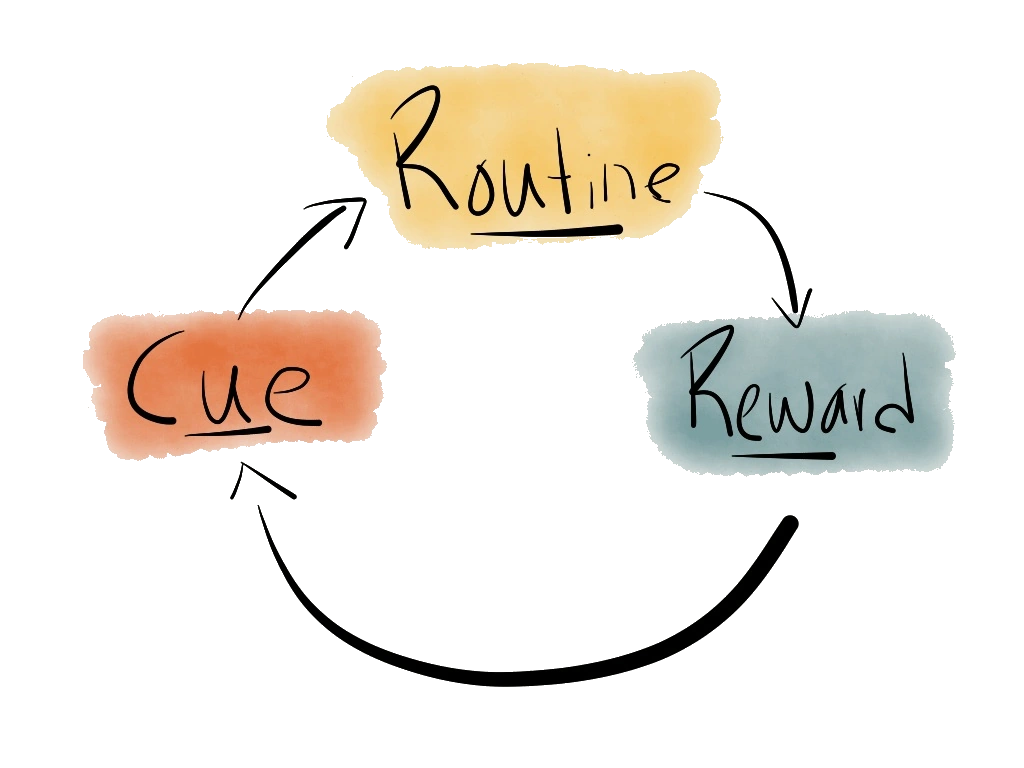
In his book The Power of Habit, Charles Duhigg explains something advertisers have known for quite some time: human beings can be trained to respond to cues with routines as long as there is a reward. He calls this the habit loop. It looks like this:

The idea is that when we have a cue, we usually will follow a certain routine that leads to a reward and if this cue occurs enough times it becomes a habit and is very difficult to break. Many habits have no particular reward but are still hard to break. Think about things Americans do not eat (cartilage, fat, and animal skin) that are good for you and if you do not eat these things, think about how gross it feels to try eating them.

Jordan Peterson: Heretic or Helpful Pagan?

February 20, 2018

Rachel Fulton Brown writes:

...I don’t think that Jordan has a Messiah complex. But I do think that he thinks that he is capable on the strength of his own will of saving the world. It is why he spends so much time speaking. Because he believes that through his speech he can save himself—and that by speaking in the way that he does, he can save everyone. Sure, Jordan uses Christian vocabulary, but he does not think like a Christian, nor does he claim to.* Rather, Jordan thinks like Nietzsche, as he shows clearly in his book.

Hildebrand on The Power of an Orderly Life

January 25, 2018

In, Transformation in Christ, Dietrich von Hildebrand explains the power of an orderly life to help us transform ourselves:


To ordain our daily lives according to some definite rule constitutes a further method in the service of our inner transformation. Apart from the specific importance which the single provisions of that rule may possess for our progress in virtue, a certain wholesome effect proceeds from order as such. It pervades life with a certain rhythm of composure and continuity, which makes it easier for us to collect ourselves; it protects us from being absorbed by the succession of varying events and impressions, so apt to interfere with our concentration upon essentials. An orderly regulation of our lives relieves us from the temptation to let our attention to prayer, contemplation, and work, our avoidance of peripheral concerns, depend on chance and circumstance; it enables us to provide systematically for the meaningfulness and depth of our existence. It makes it possible for us to acquire constancy without which all good endeavors are condemned to sterility. Finally, an established outward order also raises us above our dependence on our own arbitrary whims and momentary dispositions; it commits us from the outset, and enduringly, to our direction towards God. The last-named advantage is more perfectly attained, of course, in the case of a rule followed—as in monastic life—from holy obedience, as contrasted to merely self-devised and self-imposed regulations. In any event, however, we must keep aware of the fact that all technical regulation of life is but a means, not an end in itself; its observance must not be allowed to become a matter of rigid mechanical routine. We should not erect the rule into an absolute, nor abandon ourselves to its automatism as to a supreme law. Otherwise it may easily blunt, rather than sharpen, our perception of the call of God, and harden our hearts rather than open them to Christ.