Geoff's Miscellany

Thoughts

In all toil there is profit

January 10, 2019

In all toil there is profit, but mere talk tends only to poverty.

(Proverbs 14:23 ESV)

The proverb above is one I have always associated with one particular type of talk: talking about what you're going to do instead of doing it.

I think that this aspect is true, but incomplete. I have overly limited the meaning of talk.

Sanctification, Repentance, and the Habit Loop

January 10, 2019

Introduction to Concept:

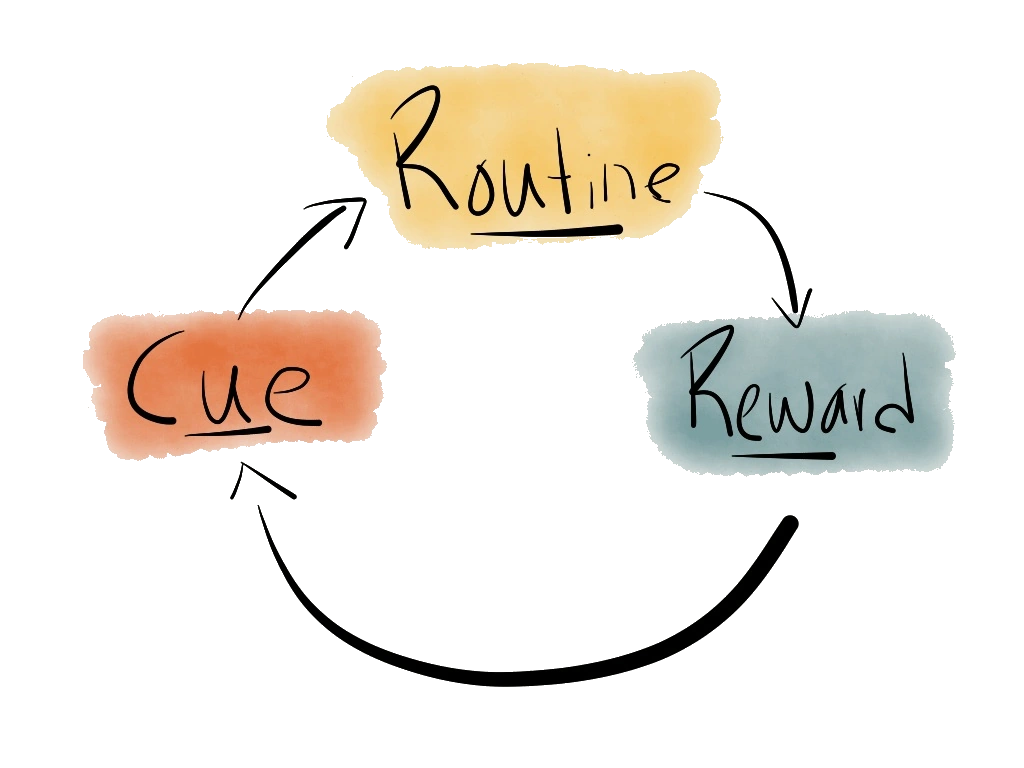
In his book The Power of Habit, Charles Duhigg explains something advertisers have known for quite some time: human beings can be trained to respond to cues with routines as long as there is a reward. He calls this the habit loop. It looks like this:

The idea is that when we have a cue, we usually will follow a certain routine that leads to a reward and if this cue occurs enough times it becomes a habit and is very difficult to break. Many habits have no particular reward but are still hard to break. Think about things Americans do not eat (cartilage, fat, and animal skin) that are good for you and if you do not eat these things, think about how gross it feels to try eating them.

What They Think

July 11, 2018

Everybody puts on the brakes before acting when they consider what others will think.

I would guess that many refuse to do what is best because of what they think.

I am often amazed at how each man loves himself more than others, but cares more for the opinions of others than of himself. If a god should appear to a man, or a wise teacher and charge him to cease to think or imagine anything which which he would not make known as soon as he thought it, he would not last one day [without breaking the command]. This is because we have more respect for the thoughts of others about us than for our own thoughts of ourselves. Marcus Aurelius, Meditations, Book XII Chapter IV*

Atheist Tricks

March 12, 2018

In the mid 2000s, it became popular for atheists to define their point of view as "lacking belief in a God." But as it turns out, the older literature is clear:

An atheist is one who denies the existence of a personal, transcendent creator of the universe, rather than one who simply lives life without reference to such a being. Atheist is one who asserts the existence of such a creator. Any discussionof atheism, then, is necessarily a discussion of theism.

Thoughts on Theodicy

February 5, 2018

One of the most famous reasons to reject the existence of God is the existence of evil. Either evil or God can exist, not both. The dilemma relies on the supposition that these three propositions cannot all be true at once

  1. God is all good.
  2. God is all powerful.
  3. Evil exists.

In modern atheist rhetoric, the whole thing is stated as though not a single Christian, Jewish, Muslim, otherwise religious person has ever noticed the potential logical hang up with believing these three things. Thus a non-Christian or atheist of some sort will point out that a good God would stop evil, a powerful God can, but evil happens therefore either proposition 1 or 2 isn't true...therefore in a non-sequitur of immense proportions, "if God is not all powerful or all good by my definition, then God does not exist."
Mike Bird, Evangelical Theology, and the Sermon on the Mount

January 18, 2018

There are a lot of things Christians "need to know." For some it's predestination, for others, the age of the earth, or the order of end times events. In reality, the core of theology is simpler than that.Mike Bird in his, Evangelical Theology reminds us of the test for Christian theology:

The Sermon on the Mount (Matthew 5– 7) and the Sermon on the Plain (Luke 6) are good test cases for any theological system.

Contra some Reformed theologians, Jesus is not teaching people the law so they can see how they don’t measure up, wail for their sinful hearts, and realize their need for the imputation of Jesus’ righteousness. Contra some dispensational theologians, Jesus is not teaching what kind of law the Jews will keep in a post-rapture millennium. The Sermon on the Mount is Jesus’ manifesto for the kingdom. It is the ethical vision for God’s people if they are to live out the covenantal righteousness that comes from experiencing the kingdom’s saving power. This is what the new Israel of the new age is supposed to look like. Not the elitist micropiety of Pharisaic leaders who claim their tradition represents the true measure of righteousness, nor the compromised Jewishness of the Herodians who dress up Hellenistic values in a Jewish garb. The sermon is about new law for the new age.

The Hurt-Feelings Fallacy

January 18, 2018

The internet made me abreast of an informal fallacy which I have dubbed:

The Hurt-Feelings Fallacy

When a premise and/or conclusion of an argument hurts somebody’s feelings or hypothetically could do so in the future, then the argument is problematic. Because of this, the conclusion and the premises are all false. Similarly, if the corollaries of the argument could cause hurt-feelings then the whole argument is false. Also, and most important of all, if the person making the argument has or potentially could stimulate hurt-feelings, then all of the arguments that person makes are totally false.

Growth and Biblical Wisdom

January 18, 2018

Everybody has a self-theory, some hypothesis or doctrine about what/who they are. Some of these theories are simple sentences like, "I'm an athlete." Others are more fundamental, like, "I'm worthless." According to Carol Dweck and Daniel Molden, our self-theories lead directly to our self-esteem maintenance/repair strategies after we fail at a task or to reach a goal. (Dweck, 130-131). They have distilled the various self-theories into two helpful categories.

Simplify Complex Problems Like Descartes

December 27, 2017

Ever Feel Stupid?

Many of us wish we were smarter than we are. Rene Descartes even felt this way:  

"For myself, I have never fancied my mind to be in any respect more perfect than those of the generality; on the contrary, I have often wished that I were equal to some others in promptitude of thought, or in clearness and distinctness of imagination, or in fullness and readiness of memory...I will not hesitate, however, to avow my belief that it has been my singular good fortune to have very early in life fallen in with certain tracks which have conducted me to considerations and maxims, of which I have formed a method that gives me the means, as I think, of gradually augmenting my knowledge, and of raising it by little and little to the highest point which the mediocrity of my talents and the brief duration of my life will permit me to reach."

The Ignorant Atheist

December 27, 2017

Richard Dawkins, never one to be pleasant, made some remarks that hold some truth value and also showcased his inability to research his historical claims. He is criticizing certain Muslim claims about the relationship of their faith to science. 

“Islamic science deserves enormous respect.” There are two versions of this second claim, ranging from the pathetic desperation of “the Qu’ran anticipated modern science” (the embryo develops from a blob, mountains have roots that hold the earth in place, salt and fresh water don’t mix) to what is arguably quite a good historical point: “Muslim scholars kept the flame of Greek learning alight while Christendom wallowed in the Dark Ages.”

Dawkins mentions the Dark Ages as a period in which Christendom wallowed in stupidity, all the while the consensus among medievalists is that the "Dark Ages" were non-existent. Also, Dawkins is probably wrong about the golden age.  In 1929 the Encyclopedia Britannica we read: