• Skip to primary navigation
  • Skip to main content
  • Skip to primary sidebar

Geoff's Miscellany

Miscellaneous Musings

Philosophy

Marcus Aurelius’ Questions for a Strong Mindset

October 5, 2017 by Geoff Leave a Comment

Marcus Aurelius - Project Gutenberg eText 15877.jpg

What am I doing with my soul? Interrogate yourself, to find out what inhabits your so-called mind and what kind of soul you have now. A child’s soul, an adolescent’s, a woman’s? A tyrant’s soul? The soul of a predator— or its prey?[1] -Marcus Aurelius Med. Bk V, chap 11
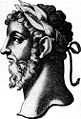
One of the most valuable exercises we can perform is to determine the content of our thoughts and the state of our souls.

With the four questions above, one of the greatest mindset writers of all time, Marcus Aurelius, helps us to determine if our mindset is strong or weak. 

Remember, strength of mind is a virtue.

  1. What am I doing with my soul?
    For Aurelius, this question means am I cultivating virtue, learning to be tranquil, understanding nature, conforming to it, and achieving the goals I set?
  2. Do I have a child’s soul, an adolescent’s, a woman’s?
    In other words, “Is my soul adequately developed for who I am?” If a man, do I shirk responsibilities like a child? Aurelius would have believed in traditional gender arrangements. So, if a man, do I fear battle? If a woman, do I think as a man who is more willing to fight than to care for my children and home?
  3. A tyrant’s soul?
    A line in the gospels helps us understand this. Jesus said that his followers should not “Lord it over” one another as the leaders of the nations do. Do I require that I get my way from everybody? While this may make one feel very powerful when it works, the decisions of others are the worst of things upon which to rely. Can you have virtue and tranquility if you possess the soul of a tyrant? Can you even have strength?
  4. The soul of a predator or its prey?
    This is particularly helpful in a culture that seems to reward behaviors of submission and retreat.[2] People don’t want to be weak and often to mask weaknesses will engage in self-destructive rather than self-constructive behaviors. Are you a predator that overcomes obstacles to seek the good? Or are you the prey that waits for problems to come your way? Are you bold as a lion or do you refuse to move forward because you fear the lion in the streets?[3]


References

[1] Aurelius, Marcus. Meditations: A New Translation (Modern Library) (Kindle Locations 1357-1359). Random House Publishing Group. Kindle Edition.

[2]


[3] See Proverbs 22:13 and 28:1.

Share:

  • Click to share on Facebook (Opens in new window) Facebook
  • Click to share on Reddit (Opens in new window) Reddit
  • Click to share on X (Opens in new window) X
  • Click to share on Pocket (Opens in new window) Pocket

Filed Under: Mindset Tagged With: basics

Foucault the Resentful

October 3, 2017 by Geoff Leave a Comment

In an long interview, two of my favorite authors/speakers discuss the problems of academia, particularly the adoption of Lacan, Foucalt, and Derrida as heroes:


Peterson’s interpretation of why intellectual elites (Paglia calls them midgets), influenced as they are by Foucault act as they do is beautiful (6:42). He essentially says that the motive force in academia is resentment virtually anything that implies merit or competence!  

Coincidentally, I just read a chapter in Hadot’s Philosophy as a Way of Life where he rather politely abuses Foucault’s misreading of the stoics. Foucault claims that the stoic notion of cultivating the self is a form of pleasure in one’s own self. But the very letter of Seneca from which he derives this view eschews self-admiration for precisely a form of contemplating ‘the best version of the self,’ or rather meditating on a transcendently transformed vision of the self in order to more fully pursue that vision. It appears to be precisely what Peterson claimed, resentment of any notion of merit or competence. 

Here’s what Seneca actually said about contemplation of the self in order to find joy:

“Real joy, believe me, is a stern matter…But it is hard to keep within bounds in that which you believe to be good. The real good may be coveted with safety. Do you ask me what this real good is, and whence it derives? I will tell you: it comes from a good conscience, from honourable purposes, from right actions, from contempt of the gifts of chance, from an even and calm way of living which treads but one path. For men who leap from one purpose to another, or do not even leap but are carried over by a sort of hazard, – how can such wavering and unstable persons possess any good that is fixed and lasting? There are only a few who control themselves and their affairs by a guiding purpose; the rest do not proceed; they are merely swept along, like objects afloat in a river. And of these objects, some are held back by sluggish waters and are transported gently; others are torn along by a more violent current; some, which are nearest the bank, are left there as the current slackens; and others are carried out to sea by the onrush of the stream. Therefore, we should decide what we wish, and abide by the decision.”

I sympathize greatly with the stoic vision of joy, though I think that it too thoroughly eschews the pleasures of sense and their role in flourishing, but for Foucault to intentionally misrepresent that as finding pleasure in the self instead of having an aesthetic view of the world. 

Share:

  • Click to share on Facebook (Opens in new window) Facebook
  • Click to share on Reddit (Opens in new window) Reddit
  • Click to share on X (Opens in new window) X
  • Click to share on Pocket (Opens in new window) Pocket

Filed Under: Literature, Philosophy

Paul Graham on what can’t be said

August 29, 2017 by Geoff Leave a Comment

I love ideas, data, speculation, experiments, and plans.

I also love arguments, refutations, and attempts at persuasion.

And I think what I love the most about the United States is the general legal consensus that outside of inciting people to acts of terrorism, one is allowed to say what they wish without government censure. In this sense, I am and have always been a free-speech absolutist. If somebody wants to make the case that a grave sin is actually sane and good, I’ll hear it. If somebody wants to claim that mega civilizations can control galaxies for energy and call it science, I’ll listen to Michio Kaku:

But, how free speechy (I think I made that up) are we?

Paul Graham suggests a test for your own free speech absolutism by positing a test for moral fashions:

What scares me is that there are moral fashions too. They’re just as arbitrary, and just as invisible to most people. But they’re much more dangerous. Fashion is mistaken for good design; moral fashion is mistaken for good. Dressing oddly gets you laughed at. Violating moral fashions can get you fired, ostracized, imprisoned, or even killed.

If you could travel back in a time machine, one thing would be true no matter where you went: you’d have to watch what you said. Opinions we consider harmless could have gotten you in big trouble. I’ve already said at least one thing that would have gotten me in big trouble in most of Europe in the seventeenth century, and did get Galileo in big trouble when he said it—that the earth moves. [1]

It seems to be a constant throughout history: In every period, people believed things that were just ridiculous, and believed them so strongly that you would have gotten in terrible trouble for saying otherwise.

Is our time any different? To anyone who has read any amount of history, the answer is almost certainly no. It would be a remarkable coincidence if ours were the first era to get everything just right.

It’s tantalizing to think we believe things that people in the future will find ridiculous. What would someone coming back to visit us in a time machine have to be careful not to say? That’s what I want to study here. But I want to do more than just shock everyone with the heresy du jour. I want to find general recipes for discovering what you can’t say, in any era.

This particular test is useful. Are my ethical standards determined by the cultural fads or careful reasoning? Christians have a tendency to feel that the Holy Spirit and deep study have prompted them toward some new ethical insight that really is just a way for them to stop being at odds with the dominant culture (sad). But my version is this:

Could you listen to the views of somebody from any time period or culture, insofar as they are not inciting terroristic or mob violence, and not want them silence, jailed, or executed?  

Obviously, this is context specific. Church services aren’t the place for giving heretics a voice, children’s classrooms aren’t the place for letting philosophical cases for sexual deviance be made, and so-on. But I think this test for free-speech absolutism is key. Am I, then, a free-speech absolutist?

Share:

  • Click to share on Facebook (Opens in new window) Facebook
  • Click to share on Reddit (Opens in new window) Reddit
  • Click to share on X (Opens in new window) X
  • Click to share on Pocket (Opens in new window) Pocket

Filed Under: Culture, Education, Philosophy Tagged With: Free Speech, MichioKaku, Paul Graham

Gloria Steinem and Moral Insanity

August 29, 2017 by Geoff Leave a Comment

For Thomas Aquinas, sanity was one’s intellectual capacity to grasp first principles and reason from them.

 For the ancient Hebrews, killing children for fertility is Molech worship.

For Gloria Steinem, neither of those are a negative:

“Are you kidding me? Listen, what causes climate deprivation is population. If we had not been systematically forcing women to have children they don’t want or can’t care for over the 500 years of patriarchy, we wouldn’t have the climate problems that we have. That’s the fundamental cause of climate change. Even if the Vatican doesn’t tell us that. In addition to that, because women are the major agricultural workers in the world, and also the carriers of water and the feeders of families and so on, it’s a disproportionate burden.”

Steinem does, to her credit, depart from other elements of the hard-left zeitgeist. But the paragraph above is nuts on several levels ranging from the commonly accepted definition of the patriarchy as a European phenomenon, the location of major population explosions, the nature of climate models, the question of whether or not children have rights, and the disjoint in her rhetoric between children and their cause.

Share:

  • Click to share on Facebook (Opens in new window) Facebook
  • Click to share on Reddit (Opens in new window) Reddit
  • Click to share on X (Opens in new window) X
  • Click to share on Pocket (Opens in new window) Pocket

Filed Under: Philosophy, Politics

How-To Even

August 23, 2017 by Geoff Leave a Comment

Previously, in the formerly current year, many people expressed their inability to even.

Here are two examples pulled from a quick twitter search for the phrase:

In this tweet, we read about a woman who is having an eye-brow problem and cannot even because of it.


In this tweet, an anonymous wo/man, who appears to protest ‘man-spreading’, ‘can’t even’ at the prospect of a Trump presidency. It’s hard to imagine the hysterics this individual is currently experiencing.

But I submit to you that you can. You can even. And here’s how:

  1. Stop publicly emoting about your inability to even. Simply note the emotion and ask, “How can I even solve this problem?”
  2. Write down what you will even do fifteen times a day, “I, so and so, will even do ‘X’.”
  3. Actually, start to even do the thing.

In three easy steps even you can even.

All sarcasm aside, it is certainly the case that saying “I can’t even” does affect how you think and act by effecting in you a static mindset or an ‘entity identity’. With your mindset so enslaved to that identity, your perceptions are aligned to reality in a fashion that no longer allows you to change.


Share:

  • Click to share on Facebook (Opens in new window) Facebook
  • Click to share on Reddit (Opens in new window) Reddit
  • Click to share on X (Opens in new window) X
  • Click to share on Pocket (Opens in new window) Pocket

Filed Under: Mindset

What is my calling?

August 15, 2017 by Geoff 1 Comment

Briefly, Jesus outlines the calling for every Christian here:

Mark 12:29-31 ESV Jesus answered, “The most important is, ‘Hear, O Israel: The Lord our God, the Lord is one. (30) And you shall love the Lord your God with all your heart and with all your soul and with all your mind and with all your strength.’ (31) The second is this: ‘You shall love your neighbor as yourself.’ There is no other commandment greater than these.”

This isn’t a very specific answer, but it’s a very significant one.

It’s in response to Jesus being asked what the most important part of the law is. Why would somebody ask that? Because they’re hoping to trip Jesus up or they’re hoping for some sort of permission or endorsement of their current way of life. In the case of the Israelites of Jesus’ day, they were looking for laws connected to overthrowing the Romans or perhaps gaining public honor through religious ritual (Matthew 6:1-18).

But the most important thing, before you start looking to do some “world changing” or “personally enriching task” is to learn to appreciate God and to bring well-being to your neighbor.

Share:

  • Click to share on Facebook (Opens in new window) Facebook
  • Click to share on Reddit (Opens in new window) Reddit
  • Click to share on X (Opens in new window) X
  • Click to share on Pocket (Opens in new window) Pocket

Filed Under: Christian Mindset, Mindset

  • « Go to Previous Page
  • Go to page 1
  • Interim pages omitted …
  • Go to page 7
  • Go to page 8
  • Go to page 9
  • Go to page 10
  • Go to page 11
  • Interim pages omitted …
  • Go to page 17
  • Go to Next Page »

Primary Sidebar

Recent Posts

  • 2020 Has Been a Big Year or I Finally Quit
  • Steps to Open a Bible College
  • You Have No Power Here, This is a Library
  • What is true wealth?
  • What’s Wrong with Conservatives?

Recent Comments

  • Sharon on Whether we live or die, Aslan will be our good lord.
  • Alishba lodhi on Effort Habit: Keep the Faculty of Effort Alive in You
  • Geoff on Why is Covetousness Idolatry?
  • Geoff on 2020 Has Been a Big Year or I Finally Quit
  • Kelly Jensen on Why is Covetousness Idolatry?

Archives

  • August 2020
  • June 2020
  • May 2020
  • April 2020
  • March 2020
  • January 2020
  • December 2019
  • October 2019
  • September 2019
  • August 2019
  • June 2019
  • May 2019
  • April 2019
  • March 2019
  • February 2019
  • January 2019
  • December 2018
  • November 2018
  • October 2018
  • September 2018
  • August 2018
  • July 2018
  • June 2018
  • March 2018
  • February 2018
  • January 2018
  • December 2017
  • November 2017
  • October 2017
  • September 2017
  • August 2017
  • July 2017
  • June 2017
  • May 2017
  • April 2017
  • March 2017
  • February 2017
  • January 2017
  • December 2016
  • November 2016
  • October 2016
  • September 2016
  • August 2016
  • July 2016
  • June 2016
  • May 2016
  • April 2016
  • March 2016
  • February 2016
  • January 2016
  • December 2015
  • November 2015
  • October 2015
  • September 2015
  • August 2015
  • July 2015
  • June 2015
  • May 2015
  • April 2015
  • March 2015
  • February 2015
  • January 2015
  • December 2014
  • November 2014
  • October 2014
  • September 2014
  • August 2014
  • July 2014
  • June 2014
  • May 2014
  • March 2014
  • February 2014
  • January 2014
  • December 2013
  • November 2013
  • October 2013
  • September 2013
  • August 2013
  • July 2013
  • May 2013
  • March 2013

Cateories

WordPress · Log in